Exploring environments across Scotland, 14 writers share the places and spaces which define their queer history.
who will be remembered here reconsiders and reimagines the built and natural environment through a queer lens, uncovering stories full of hope and humanity, and the collection features images from HES archive.
Contributors are Ali Smith, Damian Barr, Ink Asher Hemp, Mae Diansangu, Ashley Douglas, Amanda Thomson, Jeff Meek, Rona Munro, MJ Deans, Louise Welsh, Ever Dundas and Johnny McKnight, along with Lewis Hetherington and CJ Mahony who are also the book’s curators. The book features works in English, Scots and Gaelic.
2025 marks a significant point in LGBTQ history, being 30 years since the first major Pride event in Scotland. Queer history is an important part of Scotland’s past, but it is largely absent from records. By making invisible stories visible, who will be remembered here ‘captures something of the richness, complexity and beauty of a history that belongs to all of us’.
The book will be released in the 14 of August and can be pre-ordered.
All welcome, registration required. Please visit here to register.
We have always been part of Scottish history, and we continue to make Scottish history.
From the 6th century man-loving priest Findchän to the unnamed trans or intersex person (‘skartht’) whose very existence was supposedly a portent of James II’s death (1460)
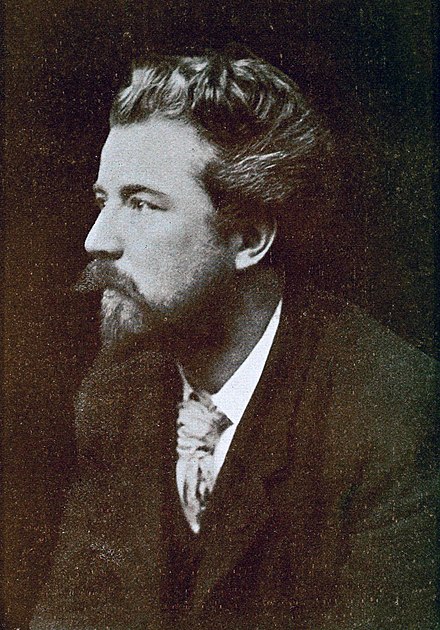
via the ‘female sodomites’ Elspeth Faulds and Margaret Armour (1625), the ‘lesbian schoolmistresses’ Jane Pirie and Marianne Woods (1810) and the gender fluid paganist William Sharpe/Fiona Macleod (d. 1905)
to the fight for repeal of ‘Section 28’ (2000), for marriage rights (2014) and for respect for trans autonomy (ongoing) and infinitely more.
Let’s share and celebrate some of Scotland’s many lgbtqi+ lives.
Gray’s School of Art alumnus, Bart Grabski, hasbeen selected as one of only ten artists to feature in the Queer & Now exhibition, a landmark project organised by Dundee’s Shaper/Caper dance company funded by The National Lottery Heritage Fund.
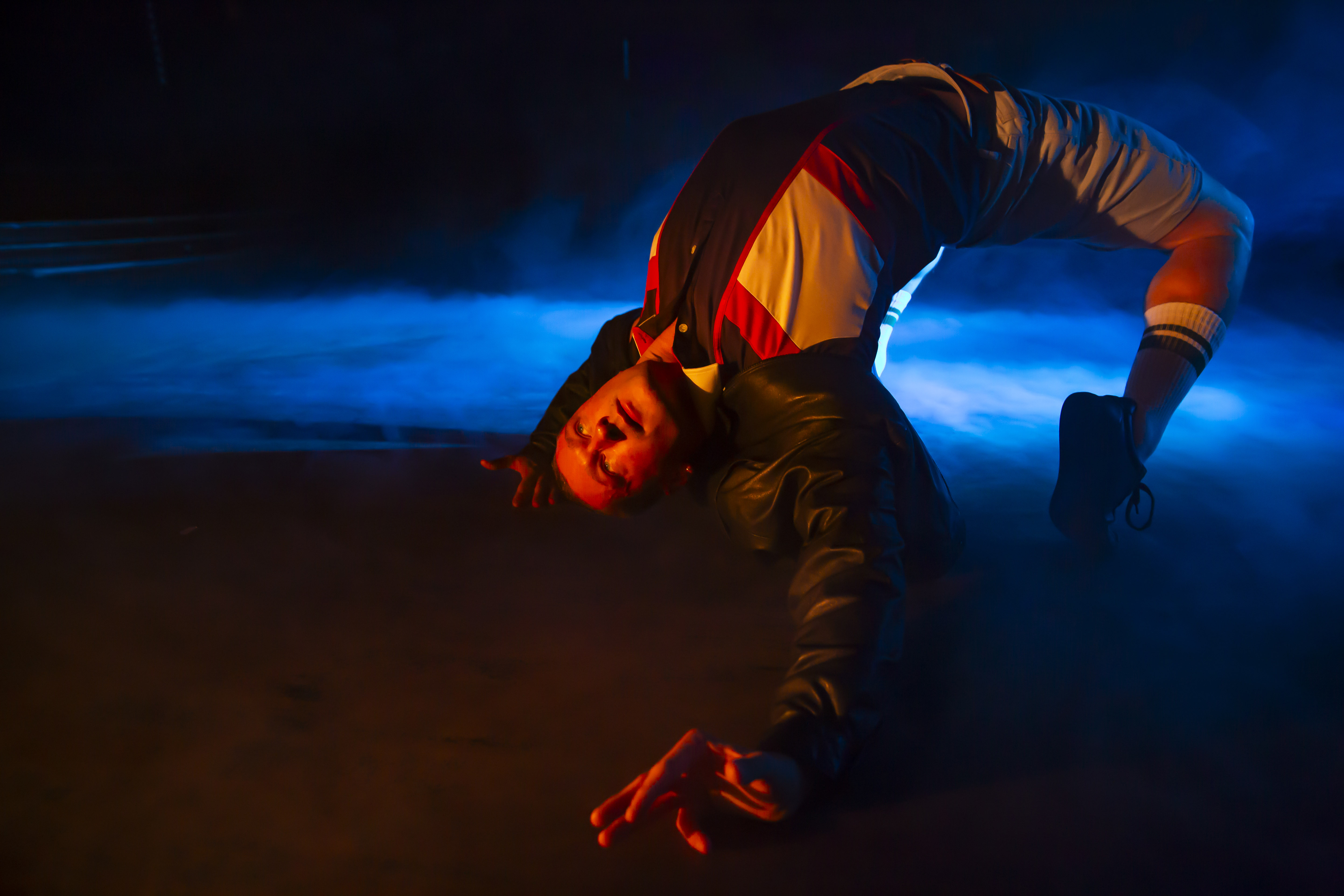
The exhibition, which runs alongside the acclaimed Small Town Boys choreographed by Shaper/Caper’s Artistic Director Thomas Small, explores the rich and diverse experiences of the LGBTQ+ community, with a particular focus on themes from the 1980s and 1990s, including Section 28 and queer nightlife.
Queer & Now showcases new work created by artists who delved into the LGBTQ+ culture of the past, working closely with OurStory Scotland to collect and curate oral histories that have deeply informed their practice.
Bart’s piece, ‘Oral Portraits’, is a poignant exploration of Aberdeen’s queer club scene during the AIDS crisis, documenting a time when underground spaces offered solidarity, resilience, and joy to the community despite oppressive laws.
Reflecting on his artistic journey, Bart said: “For many, the dance floor wasn’t just a place to escape—it was a place to become. In a world that tried to erase our community, those nights were the loudest forms of existence. This project isn’t just about remembering; it’s about honouring the resilience, the joy, and the unapologetic celebration of life that thrived in those spaces.”
Bart’s work weaves together evocative photographic portraits with a soundscape of audio recordings, featuring intimate interviews that echo the spirit of those times. He further explained, “The oral history recordings have been the soul of this project. Each story is a thread in the tapestry of our collective history, revealing not only the struggles but also the triumphs and moments of joy.”
Jill and Colin, who feature prominently in Bart’s work, offer deeply personal insights into the significance of Aberdeen’s queer nightlife. Jill reflects on her self-discovery and the sanctuary provided by Club 2000, where “music and companionship offered an escape from societal repression.” Colin shares his experience with the Gay Switchboard and health promotion during the AIDS crisis, highlighting the importance of safe spaces like Daisy’s Disco and Castros in fostering a sense of belonging and self-acceptance. Colin noted, “Those spaces were not just clubs; they were our lifelines, places where we could be who we really were without fear.”
In addition to his own personal contribution, Bart also conducted interviews with two LGBTQIA+ alumni of Gray’s School of Art, Mark and Cliff, who reflect on their creative practices during those pivotal decades. Both discuss how queer spaces, art, and creativity within Aberdeen provided an outlet for expression and community in the face of social and political challenges.
Mark shared his experience at Gray’s School of Art saying, “Art School enabled me to facilitate my creativity as an honest reflection of my true queer identity. This creative exploration would not have been possible outwith such a liberating environment.”
Cliff, meanwhile, recalls the vibrant creative community of Gray’s School of Art and how the club scene was a lifeline for many: ” Art school was a lifesaver for me, a place where I could be myself, but the queer club scene was where I found my tribe—people who embraced and celebrated their identities.”
Yolanda Aguilar, Executive Director, Shaper/Caper said: “Sharing the history of the LGBT+ community in Aberdeen is a vital thread in the fabric of the city’s past. Sharing these stories allow us to honour the resilience, struggles, and triumphs of individuals who have often been marginalised.
“Gray’s alumnus, Bart Grabski’s contribution to the Queer & Now project has been most relevant in terms of showcasing his unique artistic and interdisciplinary practice, complementing an impressive team of selected artists, whilst spotlighting the North East of Scotland as the fourth city with the highest LGBT+ population, as revealed by this summer’s census.
“Gray School of Art plays an important role by shedding light on the contribution of the LGBT+ community, promoting inclusivity, and ensuring that future generations see the rich diversity that has always been part of Aberdeen’s identity”
The exhibition has travelled across Scotland, opening in July 2024 at Perth Theatre and moving to Inverness, Stirling, and Glasgow, before arriving in Aberdeen at the Anatomy Rooms Arkade Studios from October. The highly anticipated Artist Talk will take place in Aberdeen at the Anatomy Rooms on Friday, 18th October at 4 pm, offering visitors a chance to hear firsthand from artists about the creative process and the stories that shaped their work.
The ‘Queer & Now’ exhibition runs parallel to the ‘Small Town Boys’ show, which delves into queer nightlife in the 1980s through dance and spoken word, offering a complementary exploration of LGBTQ+ experiences during a turbulent time in history. As part of the tour in Aberdeen, ‘Small Town Boys’ will be showcased at Cheers Bar, ensuring that the city has the opportunity to fully engage with both events.
Gray’s School of Art and the wider RGU community are immensely proud of Bart’s accomplishments. His work continues to elevate underrepresented voices, reinforcing the institution’s role as a vital catalyst for social change and cultural discourse. We invite everyone to attend the exhibition and the artist talk, not only to celebrate the legacy of LGBTQ+ histories but also to witness the profound impact of Gray’s School of Art on its alumni and the community at large.
Andrew King’s recent piece about older people and homophobia published on the website The Conversation got me thinking about my own research interviewees with gay and bisexual male (GBM) elders, which I undertook in the mid 2000s.
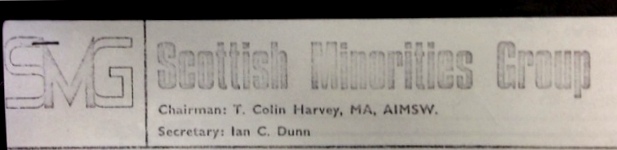
One of the notable issues concerning the homosexual law reform movement in Scotland during the late 1960s and 1970s was that it took on a largely ‘assimilst’ rhetoric. The Scottish Minorities Group (SMG), Scotland’s foremost homosexual law reform organisation believed firmly in the integration of LGB Scots into mainstream society, and demonstrated a sceptical attitude towards more radical organisations such as the Gay Liberation Front. Whether his was the result of a keen understanding of the cultural temperature of Scotland or a deeply held belief that assimilation was most desirable is debatable. What is not open to debate is that the SMG were successful in their campaign. However, some members were uncomfortable with this desire to conform; during the 1970s SMG were to suggest that although the use of police agents provocateurs to catch queer men cottaging was quite wrong, yet they also suggested that men who cruised for sex suffered from behavioural or mental difficulties.
When I interviewed two dozen older gay or bisexual men I was keen to understand whether assimilation and conformity was something that they had sought. Or had they been influenced by more radical approaches. ‘Brian’, born in 1936, saw more radical, politicised campaigning as unnecessarily confrontational. He included PRIDE events in this:
I’ve never taken part in [PRIDE]…and I don’t think I ever would; not my scene… Self-advertisement, there is a lot of that in it too, you know… But there is a certain breed of homosexual that wants to challenge all the time, they want to thrust it in your face.
Perhaps unsurprisingly, Brian never participated in the gay rights or homosexual law reform movement, but does donate to LGBT support groups and charities. Brian was content separating his life into public and private spheres, only occasionally merging the two. Brian also feels uncomfortable about the contemporary gay ‘scene’; never venturing into gay bars. For Brian the ‘queer scene’ during the 1950s was governed by discretion, a quality that he has become rather nostalgic about. A lack of discretion, according to Brian can be problematic for today’s generation of LGBT Scots, as he described in a recollection of the experiences of a younger gay neighbour:
Until quite recently there were two gay boys living in this street. Funnily enough they had told me that certain people in this street actually shunned them because they were a gay couple. Now, I can believe it up to a point but I think that one of them in particular was kind of challenging people all the time to acknowledge him. He would go on about how they refused to acknowledge my partner…there was this sort of aggressive thing about, ‘You’ve got to recognise me for what I am and not for something else’. Is that necessary?
Nostalgia for a previous, less ‘complicated’ era may sound rather contradictory. The era is which my interviewees operated was an era where homosexual acts were illegal (although rarely prosecuted unless they took place in public), so discretion was not a choice it was a necessity. All of my interviewees were pleased that things have changed in Scotland, and many were envious of today’s generation who largely avoid engrained homophobia and scepticism. Yet, for some, something had been lost.
Robert, born in 1937:
It’s that slight double life thing and there is a feeling of pleasure in that. [It] fed something in me.
Yet, despite the ‘simplicity’ of the double life, it has left its mark on Robert’s ability to engage with a modern generation of GBM, and engage in meaningful relationships:
I’m deeply fucking annoyed that I have got to this age and I’m still so unfulfilled in areas of having a good connecting relationship and what fucking chance do I have now because of age and there is a bit of me that knows that I can’t do it but I do feel quite resentful that I have been deprived of that…
Alastair (b. 1948) was also quite nostalgic about being queer in Scotland during the 1960s and 1970s:
[There was a] lot of excitement because there was so much going on and whether or not it was legal didn’t actually matter too much. I can’t remember anybody having a great celebration party when the law changed, it just happened. [There was] a little bit of fear and a GREAT deal of excitement. The 60s were so exciting anyway and you know what they say, if you remember the 60s you weren’t there but I do actually remember quite a lot about it and the 70s were pretty wonderful too!
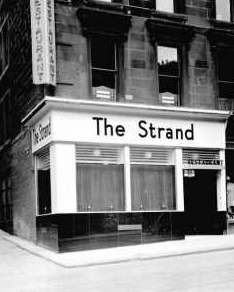
Queer-friendly bar, Glasgow, 1950-60s
However, one must be careful not to assume that because Alastair, Robert and Brian enjoyed the excitement and thrills of queer life in post-war Scotland, that they were unconcerned about the denial of basic human rights to non-heterosexual men. Perhaps there is a temptation to view the years before decriminalisation as characterised by unrelenting misery, loneliness and isolation but what became clear from my interviews was that queer men created opportunities for pleasure, sex, love and companionship.
When I asked Morris (b. 1933) if he was in any way envious of young LGBT Scots of today he gave it considerable thought:
[Long pause] I think they are enjoying a remarkable freedom….I think they are lucky and yet at the same time, I don’t know. [It’s much easier now] and maybe they just don’t appreciate that. It was fun when you are being criminal you know, and getting away with it, it was fun doing it right under their very noses. You were having the time of your life and they didn’t know, well you hope they didn’t know!
Morris told me he would much rather have experienced queer life today as a young man rather than queer life in the 1950s but, at the same time, he would not change his past. His experiences, good and bad, helped form who he has become. However, the dramatic shift in lived experience for GBM today as compared to 50 years ago has led, in many instances, to a feeling of disconnect for some of my interviewees. I’ve already detailed Brian’s frustration caused by, in some part, so many years living a double life. Other interviewees told me how they find it difficult or challenging to relate to the ‘younger generation’.
Chris (b. 1958) told me:
When I am talking to gay men just now who are their teens or 20s it’s something they don’t even think about it [the struggle]… Just to be on that Gay Pride march every year in the early stages when people would throw things at you, was a political statement…
For Chris and other interviewees, the past was not another country: it played a part in forming the fabric of today, and some queer Scots of a younger generation are unaware or perhaps unappreciative at the endeavours, both personal and political, of their LGBT elders. While Joseph (b. 1959) has great admiration for this younger generation of LGBT Scots, who he believes, in the main, are aware of past sacrifices and battles, he does believe that commercial interests now dominate the ‘gay community’, which has been reshaped to attract certain groups:
I’m trying no’ tae generalise as it’s important no’ tae generalise but I do find on the commercial gay scene that there is an ageism which is very prevalent. I don’t actually buy into the idea that the gay scene is necessarily welcoming and affirming to everybody. I think individuals in that scene are but I don’t think that the commercial gay scene as a whole necessarily is and I think there is a lot of discrimination at work. You go to [a popular Glasgow gay bar] and you hear young people say, “What’s that old bastard doing here?”
Of course, ageism isn’t restricted to aspects of LGBT communities but is perhaps more pronounced due to its spatial limitations. Colin (b. 1945) acknowledges the problems of elder LGBT visibility, not only within queer commercial enterprises but within wider society, ‘it’s as if they’re not there…invisible’, but accepts that when he was younger and visiting gay bars in London he also participated, to some extent, in this process: ‘I was drawn into that consumerist world’. Joseph argued that LGBT life should not be measured by the merits and failures of a commercial LGBT ‘scene’, which he feels has been dressed up as being reflective of LGBT experiences. He argued that for many years the LGBT commercial scene was more a ghetto than a community; a place where a marginalised group could theoretically meet, communicate and engage. But as with most ghettos, Joseph feels that it offers you what you want/need for a while until A – you need or are able to find something more rewarding, or B – you no longer feel part of it, or are excluded.
My interviews with these GBM over 50 offered an alternative view of ageing, connection and disconnection, community, and isolation experienced by a sexual minority in Scotland. None of these men wished a return to some sepia-tinted, halcyon queer past but wished to make two main points: queer life during the post-war period wasn’t all misery, gloom and furtive fumblings; there was colour, vigour and plenty of evidence of how queer men shaped their own experiences in the face of hostility, homophobia and potential criminalisation. Secondly, the march of progress, and widening rights was met with relief and joy by these men but they were conscious of how their experiences had led to a measure of disconnection with a later generation of LGBT Scots.
Recently I inherited (after a colleague retired) a large collection of LGBT magazines and ephemera stretching back to the early 1980s. These include numerous editions of Gay Scotland and Gay Times, which are helpful resources when examining the development of LGBT culture over the past 30 years.
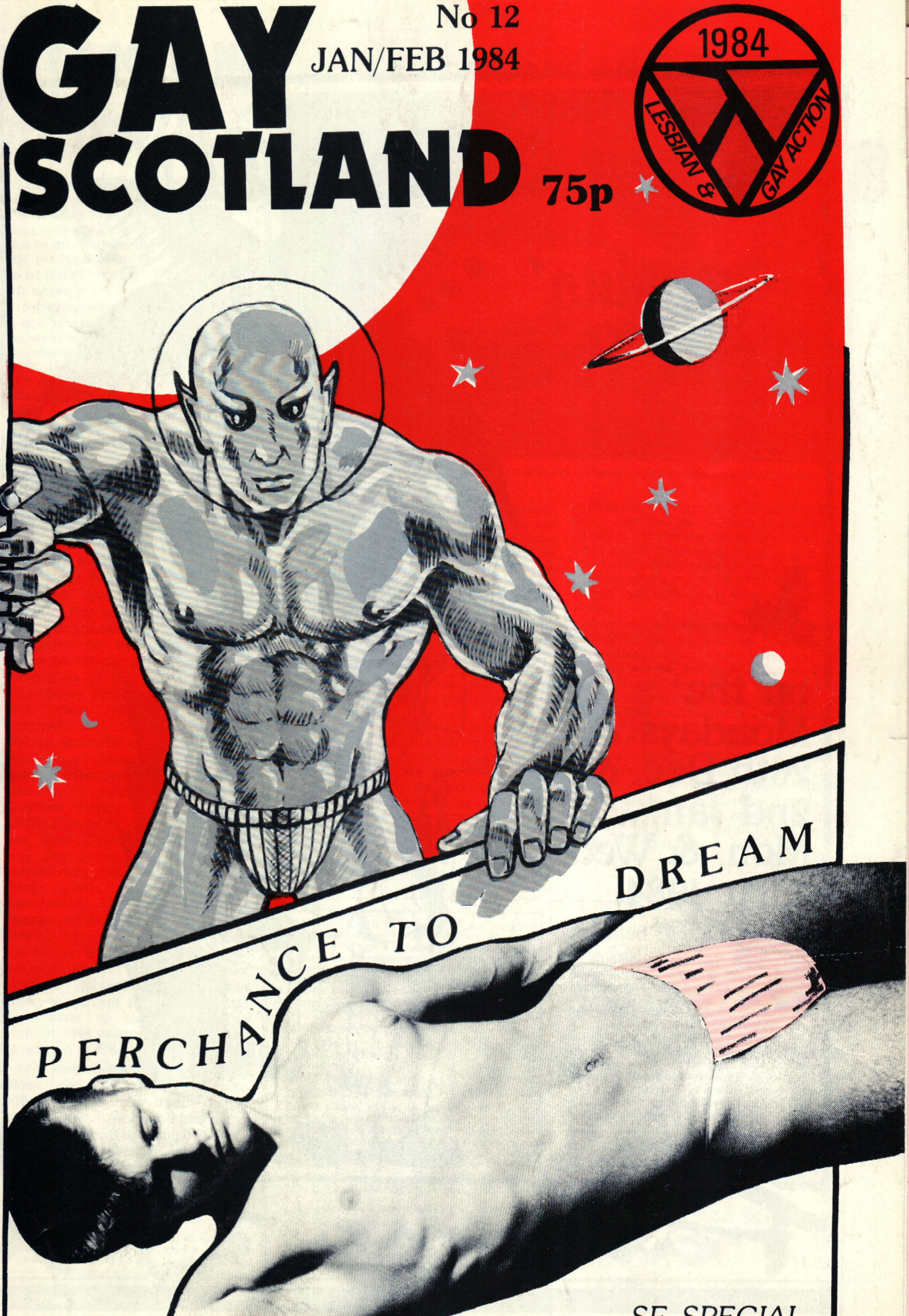
Gay Scotland Jan/Feb 1984
Take, for example, this issue of Gay Scotland from Jan/Feb 1984 – a Science Fiction special. At this time the magazine had a circulation of around 8,000 with the majority of readers subscribing or buying a copy from gay bars and clubs. What is noticeable from the content is that the magazine contains significantly less advertising space than more recent magazines, and offers a plentiful supply of news items, which are unsurprisingly related to LGBT interests and the continuing pursuit of equality and an end to discrimination.
What interested me was the section ‘Scenearound’ detailing places and spaces for LGBT Scots to socialise. A snapshot of the gay ‘scene’ in 1984 offers some opportunity to consider how the ‘scene’ had developed after 1980. There were gay/mixed spaces prior to 1980; in Glasgow; there was the Close Theatre bar, Guys, The Royal, the coffee bar in the Central Hotel, Top Spot Mexicana, The Strand, the Corn Exchange, and Tennent’s to name a few, but after 1980 there was growing confidence that commercial premises catering for the LGBT population could be profitable and offer a safe(r) experience for Glaswegian LGBTs.
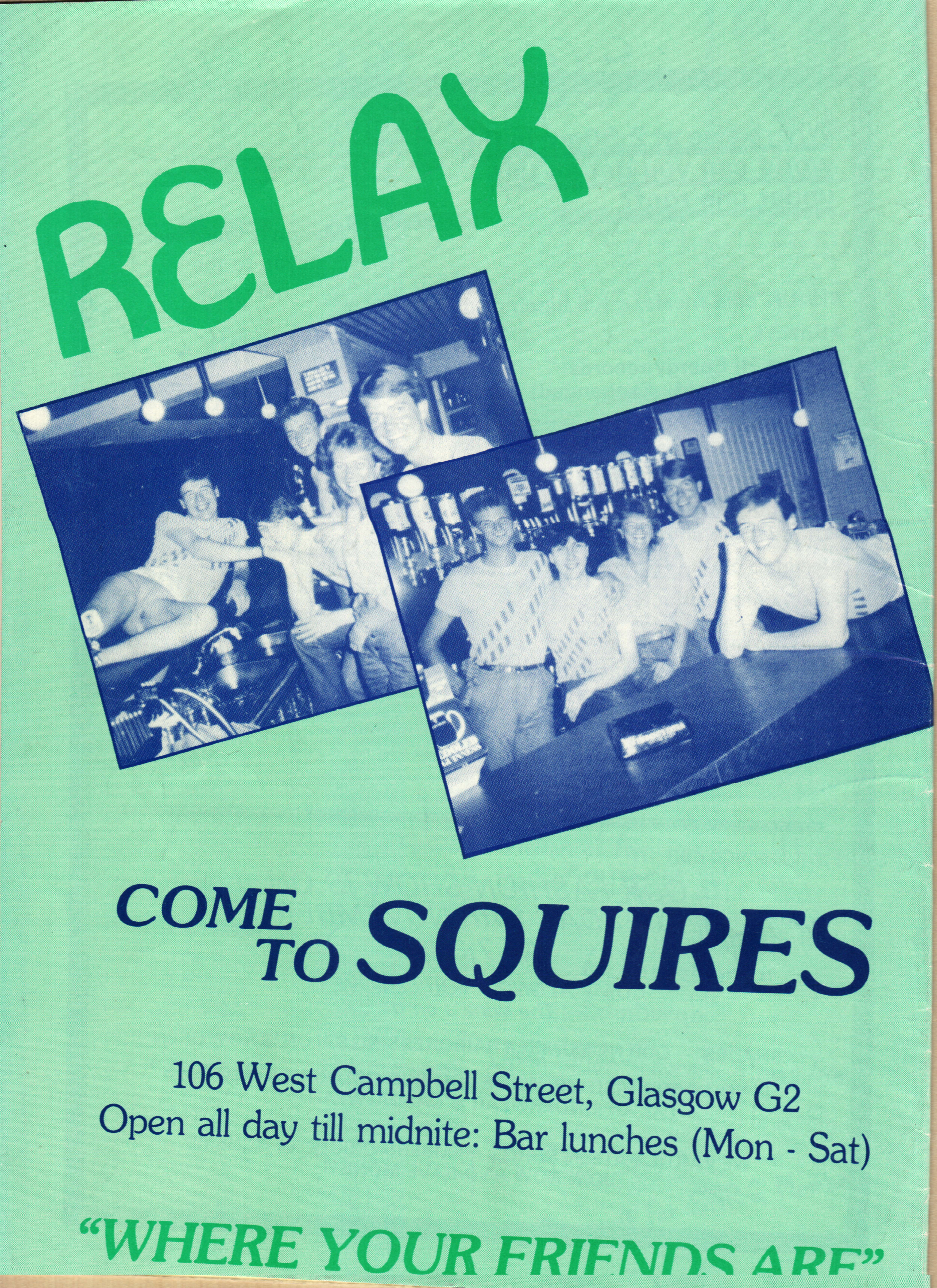
According to the listings there were 13 gay or gay ‘friendly’ pubs ‘n clubs in Glasgow in 1984. Some will be familiar to those of us ‘of a certain age’: Court Bar, Squires, Tennents, The Waterloo, Bennets. But there are more: Bardot’s at 72-74 Broomielaw, incorporating La Maison & Le Village; Studio One on Byres Road (mainly Sundays); Vintners, Panama Jax, and Halibees Cafe Cabaret. However, due to the transient nature of many ‘gay’ venues, by November Bardot’s seems to have disappeared, and Halibees is no longer listed. New entries include Cul de Sac on Ashton Lane, Chippendales on Clyde Street, & The Winter Green Cafe. Editorial notes offer readers a glimpse of what to expect: Duke of Wellington – ‘rough, but ready clientele’; Vintners – ‘busy [and] cruisy’; Cul de Sac – ‘trendy…popular with a certain ‘set’; Squires – ‘up market…popular with tourists’.
Squires Lounge
If we leap forward another 10 years to July 1994, Glasgow had 16 venues listed, including a new generation of gay pubs ‘n clubs; much more commercial and appealing to the ‘pink pound’ younger market. Café Delmonicas, Club X, and Mondays at The Tunnel boasted a much more music-oriented culture. The ‘old guard’ were still represented by the Court Bar, Squires, The Waterloo, Austins and, to some extent, Bennet’s but the 90s saw the emergence of a distinctly different form of gay leisure culture. This new culture was characterised by a more confident and market-savvy approach that relied upon a younger and more affluent customer base. Characterful, they were not. But this gay scene was replicating the changes that were occurring more broadly within the leisure industry, which was becoming a more customer-driven platform, and introduced a new phase in the evolution of gay commercial culture in Scotland which saw an alignment with the mainstream.
The language of gay Scottish leisure changed too. Whereas venues in the 1980s might have been described as ‘discreet’, ‘cruisy’, ‘closeted’ or ‘tolerant’, by the mid 1990s such descriptions were absent. These changes were replicated in the LGBT publications of the period too, which reflected increased revenue, appeal, and confidence and were able to expand content to include more than activism and awareness of LGBT issues.
Gay Scotland Nov 1994
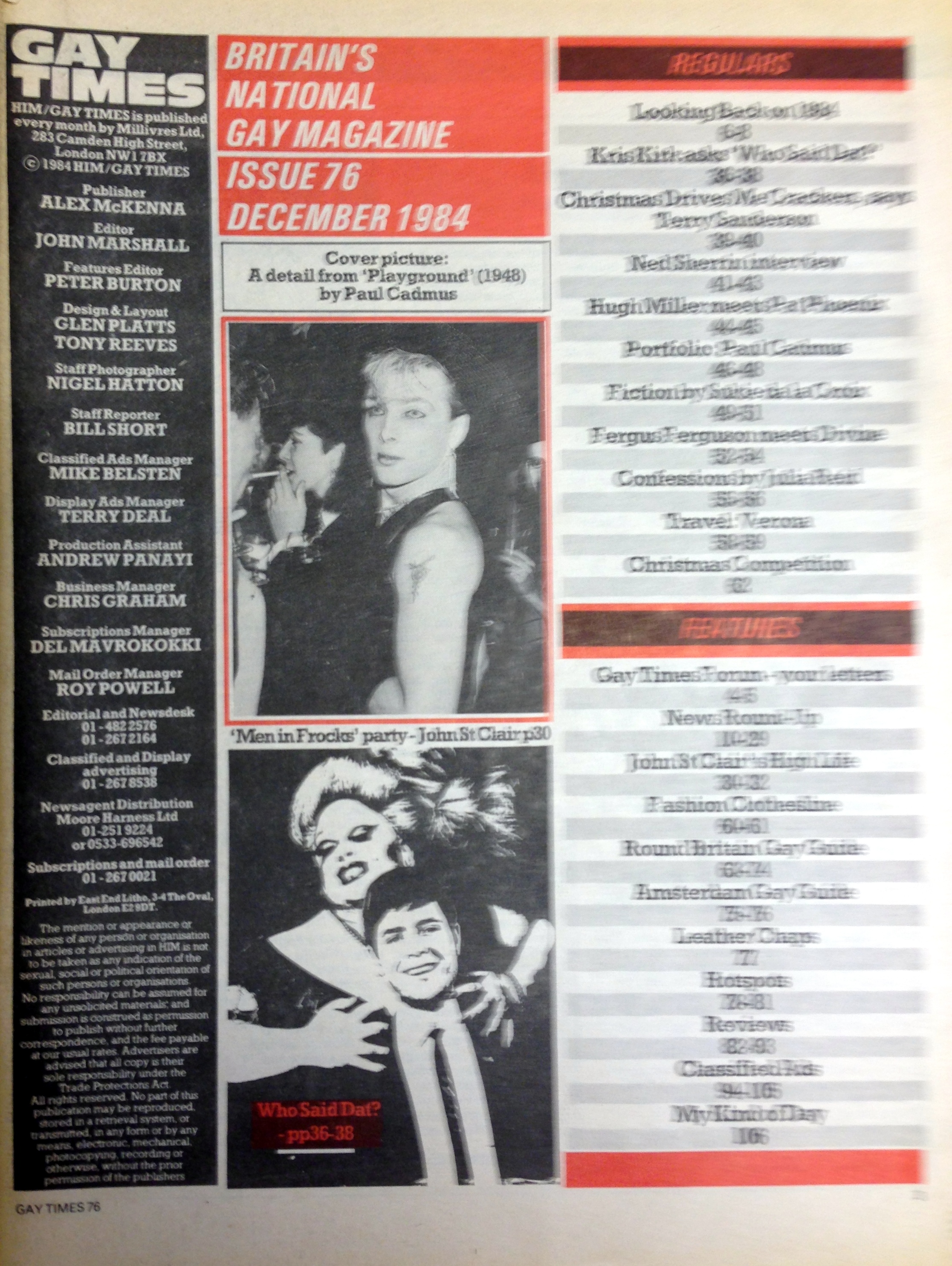
A similar progression can be seen in Gay Times between 1984 and 1994:
Gay Times 1984
Gay Times 1994
The ‘streamlining’ of commercial gay culture in Scotland has led, in some instances, to the narrowing of its appeal. Modern venuesmay be guilty of permitting market forces to disregard sections of the community: the older and less well off, in its drive for profitability and commercial appeal, with LGBT 0ver 50s frequenting venues in fewer numbers. This was certainly a feature evident from my research with gay and bisexual men over 50; some of whom felt that this drive towards profitability over community was gradually excluding the more mature or alternative ‘markets.






 Queer Scotland