Langside Hall: A Concise History

langsidemod

By the midpoint of the 19th century successful businesses wished to build offices that reflected their optimism, growing wealth and confidence, especially at a time when Glasgow was cementing its position as the second city of the Empire. One such organisation, which emerged during the early part of the century was The National Bank of Scotland (NBS) (established in 1825) and after a failure to acquire the Glasgow and Ship Bank, the NBS undertook to open their first Glasgow branch in 1843.  Occupying temporary accommodation in the first instance the bank launched a public competition to design a more suitable building. A young London architect, John Gibson (1817-92), then working under Charles Barry, entered the competition and his plan was unanimously chosen as the winner. On Gibson’s first official trip to the city he was treated to a public dinner given by the ‘principal gentlemen of Glasgow’ and commented that ‘I was much gratified by the kindness shown to me in Glasgow, and surprised to see so many public monuments, and all by the best sculptors’. After the final plans were approved construction of the new building, in Queen Street, began that winter and was completed within 4 years.

According to ‘The Glasgow Tourist and Itinerary’ (1850) the completed building was ‘commodious and elegant; the telling-room being elaborately ornamented, and its polychromatic decorations [executed by H. Bogle & Co., Glasgow, house painters to the Queen] are tasteful and appropriate’.  An article in The Civil Engineer and Architect’s Journal in September 1849 confidently stated that ‘there is not yet one building of the class in all the metropolis which offers anything like the same degree and completeness of embellishment’.
PTDC0020

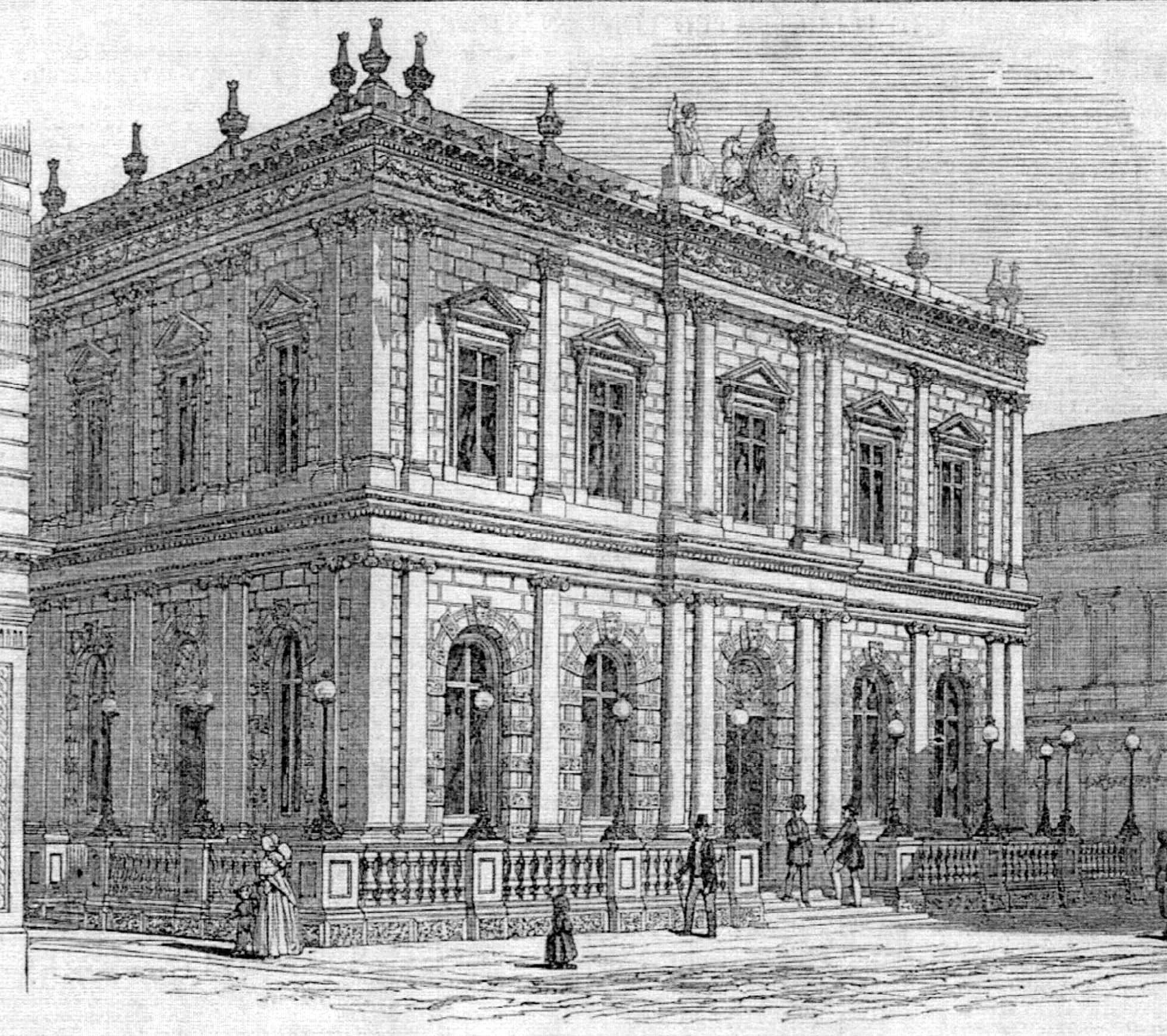
An engraving of the National Bank building, 1849

The exterior of the building was similarly lauded for its beauty. The building’s inspiration was to be found in the work of Vincenzo Scamozzi, the Venetian architect, with the ground floor rusticated with five arched openings, the centre opening housing the doorway.  The entrance is flanked by double Ionic columns.  The windows are separated by pilasters (flat columns, flush to wall), which appear in double form at the corners of the building. The original door was of a bronze-green colour and was ornamented with bronze paterae (circular ornaments) and studs.

PTDC0021

The Telling Room of the Bank

The architectural design of the building was impressive but was further improved by the addition of sculptures designed by London’s John Thomas (1818-62), who was to work often within Glasgow, and worked on the Houses of Parliament, Balmoral, Windsor, and Buckingham Palace, and became a favourite artist of Prince Albert. The Prince commissioned Thomas to create two large bas-reliefs of ‘Peace’ and ‘War’ for the latter palace. Thomas was to create the Graeco-Egyptian Houldsworth Mausoleum at the Necropolis and the designs for the industrialist Houldsworth’s new home at 1 Park Terrace. For the National Bank, Thomas ornamented the windows with carved keystones representing major rivers of Britain (the Clyde, Thames, Tweed, Severn & Humber – although there has been some dispute as to whether the latter two were in fact the Shannon and Wye).

A small bust of Queen Victoria was placed in the centre of the attic frieze. Portland stone Vase finials and the Royal Arms, supported by a unicorn and lion,  ornament the roof frontage of the building which was faced with stone with a light-grey tint, supplied by the Binnie Quarries near Edinburgh, and the masonry was executed by John Buchanan.  The side of the building was similar in design to the front but had only three windows per floor, divided by double pilasters. The rear of the bank had an out-standing gallery, within which stood another entrance which was ornamented by Ionic columns.

The interior of the building was resplendent with the telling-room of the bank boasting a 23-foot in diameter dome filled with colourful stained glass, provided by Ballantine & Allan of Edinburgh, who had also provided the stained glass for the House of Lords.  The walls were decorated with columns and pilasters painted a deep red, with white bases and tops. Near the base of the pilasters a band of black marble framed the flooring. The frieze above the columns was adorned with roses, shamrocks and thistles. The ceiling, following this colourful design, was crimson, blue and gold, with this work being undertaken by the Glasgow firm, Bogle & Co. The floor between telling counters (carved from mahogany), directly beneath the dome, was paved with coloured marbles, which in the centre formed a radiating star. The telling-room was positioned to the rear of the building and the front area was to be found along a handsome corridor, adorned with panels of contrasting colours, which led to a committee room, manager’s room, and waiting room.

So enthralled with the design of the building, The Civil Engineer and Architect’s Journal (1849) enthused that ‘the Scotch seem to have got greatly ahead of us in tasteful as well as liberal decoration of places of public business’. However, such splendour, which had initially excited the Bank’s directors, was to lose its appeal as the 19th century progressed. By 1896 the NBS was seeking new and more suitable premises for its business in Buchanan Street, at the junction of Buchanan Street and St Vincent’s Street. In a letter to architects a representative of the Bank’s directors stated ‘My directors do not favour the idea of anything of the nature of elaborate decoration…and have expressed a leaning towards a thoroughly businesslike building…of chaste design’.

Thus, the future of the building appeared bleak by the tail end of the century.  However, efforts were already underway to purchase the building from the NBS. In November 1896 an offer from Mr Richard H. Hunter, philanthropist and chairman of Hunter, Barr & Co Ltd, wholesale warehousemen & shipowners, was accepted on the provision that the Bank could continue to occupy the building for a further 4 years, while their new premises were constructed. However, this initial bid failed, but the same company made another offer in July 1898 to purchase the building for £59,000. The Bank rejected this bid and were holding out for an offer of £60,000, which they received in August the same year with provision to allow the bank to remain in the premises until 1901. Hunter was to retain the land from the sale and on this built the Hunter Barr Building (which still occupies the site today) designed by David Barclay.

From Bank to Public Hall: The Rebirth

One of the problems Glasgow Corporation had faced in supplying a public building for the Langside, Battlefield and Mount Florida districts (promised after annexation) was where to build.  After annexation a committee was appointed by the ratepayers of the districts to negotiate with the corporation.  After much discussion, bickering and frank exchange of opinions 3 main ‘preferred’ sites were identified: 1. The north side of Battle Place, on the Camphill Estate 2. The south side of Battle Place on ground owned by two proprietors 3. At the junction of Langside Avenue and Pollokshaws Road, also in the grounds of Camphill (the least preferred).  Positioning the halls at the place of Queen Mary’s defeat at the Battle of Langside was initially viewed by the corporation as the victory of sentiment over practicality.   In 1899 Bailie John Oatts suggested that the south side of Battle Place was the most preferred site but purchasing the ground would prove to be too expensive. The north side was problematic as the elevation of the ground would prove troublesome to builders. The land at the junction of Langside Avenue and Pollokshaws Road was problematic as the position of the new halls would favour the residents of one district.  It would appear that the chosen site, the latter of the options, was a compromise.

Yet, the decision met with considerable protest from sections of the local community who took exception on two grounds: the encroachment onto the Camphill grounds & the geographical positioning of the new halls. Indeed, in 1901 a committee of ratepayers took their objections before Sheriff Guthrie and the corporation were accused of being ‘high handed’ while the objectors were accused of ‘humbugging’. Further, the objectors did not believe that the former National Bank building, newly acquired by the corporation, was fit for purpose. The building had not been retained by Hunter after he purchased the site in Queen Street and the offer of a ready-made public hall was too tempting for Glasgow Corporation to dismiss, even if it meant bringing it, brick-by-brick, to the Southside.

Once the lengthy discussions had ceased and legal objections had been rejected Alexander Beith McDonald was instructed to re-design the building’s interior (although the bulk of the work was undertaken by Robert Horn).  A utilitarian building was needed so, regrettably, much of lavish interior was removed (the interior had previously been altered under the direction of James Salmon in the mid 1850s).  The entrance was given a green-tiled hallway and a double staircase was constructed which led up to the lesser hall (with gallery), which when finished could house 320. The upper hall was designed to accommodate a further 100 souls, while the former telling-room was turned into the large hall, which could accommodate 850.  Sadly, the splendid stained glass-filled dome was removed entirely and the plasterwork replaced.  A reception room was designed to accommodate around 20 people, and several smaller spaces were created. The new Langside Public Halls were also equipped with cloakrooms, a buffet, and kitchen.

After much delay, deliberation and some dissent, the new halls for Langside were officially opened on the 24 December 1903.  The Lord Provost John Ure Primrose, Baronet, was unable to attend due to a prior commitment and his place was taken by Councillor William Martin, the convener of the special committee of halls, Councillor W. F. Anderson and Bailie Finlay.  Finlay, acting on behalf of the Watching and Lighting Committee accepted custody of the halls.

Councillor Anderson informed the gathered crowd that the builders who had re-erected the building using the 70,000 numbered stones recovered from the demolished bank building did so without seeking a farthing of profit, which was met with applause. Those attending the opening were treated to vocal and orchestral concert.  This grand opening was covered by the Glasgow Herald and The Scotsman newspapers, amongst others, in their Christmas Day 1903 editions.

Over the past century Langside Public Halls have played a significant role in the south Glasgow community. The halls have figured prominently in the rich and diverse social and political history of the city, playing host to John Mclean and the famous Red Clydesiders (Maclean was arrested 4 times outside the halls), Sylvia Pankhurst and the Scottish branch of the Women’s Social and Political Union, and the Scottish Young Conservatives annual conference.  It has been a true community hall where Glasgow Progressive Synagogue was temporarily based, where the annual Glasgow Congress ‘International’ chess event packed out the main halls, where the world famous Smetana Quartet of Prague performed in concert, and where the resident band The Crackerjacks filled the floor of the large hall in the 1950s.

John Maclean

The story of Langside Public Halls is a truly remarkable one.  It is a story of architectural excellence and a story of survival.  With the removal of the National Bank of Scotland, Queen Street Office to the southside of the city one of Glasgow’s most admired buildings survived to play a central role in the social and community history of the area.


Copyright © Jeff Meek 2013

All Rights Reserved.

James Adair: Lord Protector of Scottish Morality

Few names will stir the emotions amongst LGBT Scots, who were alive during the deliberations of the Wolfenden Committee, than James Adair OBE. Adair wasn’t the only Scot to sit alongside John Wolfenden, but he is probably the most in/famous. He was to disagree fundamentally with the recommendations of the committee regarding homosexual offences and produced a minority report that questioned the moral reasoning of decriminalising homosexual acts between men.

James Adair
James Adair c.1957

In the 2007 BBC 4 drama, Consenting Adults, Adair was played as a somewhat disagreeable and pompous man, by the actor Sean Scanlan. Just how pompous and disagreeable he was is difficult to ascertain as we know so very little about this former procurator-fiscal, who had a long and successful career as a prosecutor. What we do know is that he was an elder of the Church of Scotland who grabbed many column inches through his unwavering opposition to homosexual law reform. He lived to see the change in law in England and Wales in 1967, and in Scotland in 1980, as he died in January 1982 at the ripe old age of 95 (this is despite being ‘killed off’ by Lord Ferrier – Victor Noel Paton – in a debate regarding homosexual law reform in Scotland, in 1977). Adair outlived his wife Isabel, by 32 years.

The purpose of this blog post is to flesh out the rather one dimensional view we have of Adair, whose portrait above does little to add personality or vigour to the name. Born in Barrhead in 1886, Adair was the eldest son of William, an iron turner and Catherine, and he grew up in George Street and Barnes Street, Barrhead. On leaving school at 13, young Adair took employment as a clerk in a local legal office. Adair was obviously motivated by this early exposure to the legal profession, as he studied law at Glasgow University, eventually qualifying as a solicitor in 1909, and entering private practice in criminal defence, serving his apprenticeship with Glasgow solicitors Brownlie, Watson & Beckett. In 1919, at the instruction of J. D. Strathern, he was appointed procurator-fiscal depute, with his first case, the George Square Riots of 1919. In 1933, a year after he transferred to Edinburgh,  he was involved in the Kosmo Club trial regarding ‘immoral earnings’. In 1937, he succeeded Strathern as procurator-fiscal at Glasgow.

Adair had a particular interest in morality, perhaps fostered by his membership of the Church of Scotland, and was associated with the National Vigilance Association of Scotland, particularly during the period of WWII, when he was delighted to announce to the NVAS that in Scotland the war had resulted in very few ‘fallen women’. Away from his legal and moral duties, Adair was to build a reputation as an entertaining public speaker on topics such as; Old Glasgow Streets, Old Glasgow Characters, and Edinburgh Life. He also had a long association with the Scottish Burns Federation (I wonder what he made of Burns’ ‘interesting’ sexual life), and with the Young Men’s Christian Association (he was the chairman of the Scottish National Council & from 1962, World President).

But it was Wolfenden that pushed Adair onto the public stage. Adair’s greatest fear was that law reform would have a devastating effect on the young in Scotland (Lord Arran appears to have picked up this particular baton recently). He stated that: “The presence in a district of…adult male lovers living openly and notoriously…is bound to have a pernicious effect on the young people of that community”. Adair’s proclamations of doom were seized upon by the Scottish press, with The Bulletin & Scots Pictorial lauding his input: “We should be glad if the things discussed…could be wiped out altogether…There is not much doubt that this disgusting vice has been becoming…more ‘fashionable’…”. The Scotsman took a similar editorial stance, and the Daily Record could barely conceal its outrage. Speaking at the General Assembly of the Church of Scotland in 1958, Adair caused panic in the cloisters by claiming that within weeks of the publication of the Wolfenden Report, a homosexual ‘club’ in London, offering information on meeting places including public lavatories, had received nearly 50 applications for membership, and in one square mile of London there were over 100 male prostitutes offering depraved services. Adair’s fear was that any change in law would enable ‘perverts to practice sin for the sake of sinning’ in Scotland.

Yet, there was an element of mendacity about Adair’s claims. He would have known, first hand, that homosexual prostitution was already thriving in Scotland by the turn of the 20th century and by the 1920s there were organised groups of male prostitutes operating in Glasgow – a city, he had previously hinted, with a a greater attraction for gay men. In reality Adair was upset that the previous policy of ‘silence’ regarding same-sex desire in Scotland was under threat, and by emphasising the potential for moral turpitude, he hoped to consign homosexual law reform in Scotland to the dustbin. In any event this was what effectively happened due to the peculiarities of Scots Law. Adair became a representative, a figurehead, for moral objections to homosexual law reform in Scotland, and would have been quietly satisfied that within a few months of the publication of the Wolfenden Report, Scottish silence had been restored (albeit to be resurrected in the mid 1960s, but with a similar result). Adair, his job done, could retire into relative obscurity, appearing now and again from his home in Pollokshields to offer a talk on old Glasgow, or to attend meetings of The Galloway Association of Glasgow.

Copyright © Jeff Meek 2013

All Rights Reserved.
Queer Places

Recently I inherited (after a colleague retired) a large collection of LGBT magazines and ephemera stretching back to the early 1980s. These include numerous editions of Gay Scotland and Gay Times, which are helpful resources when examining the development of LGBT culture over the past 30 years.

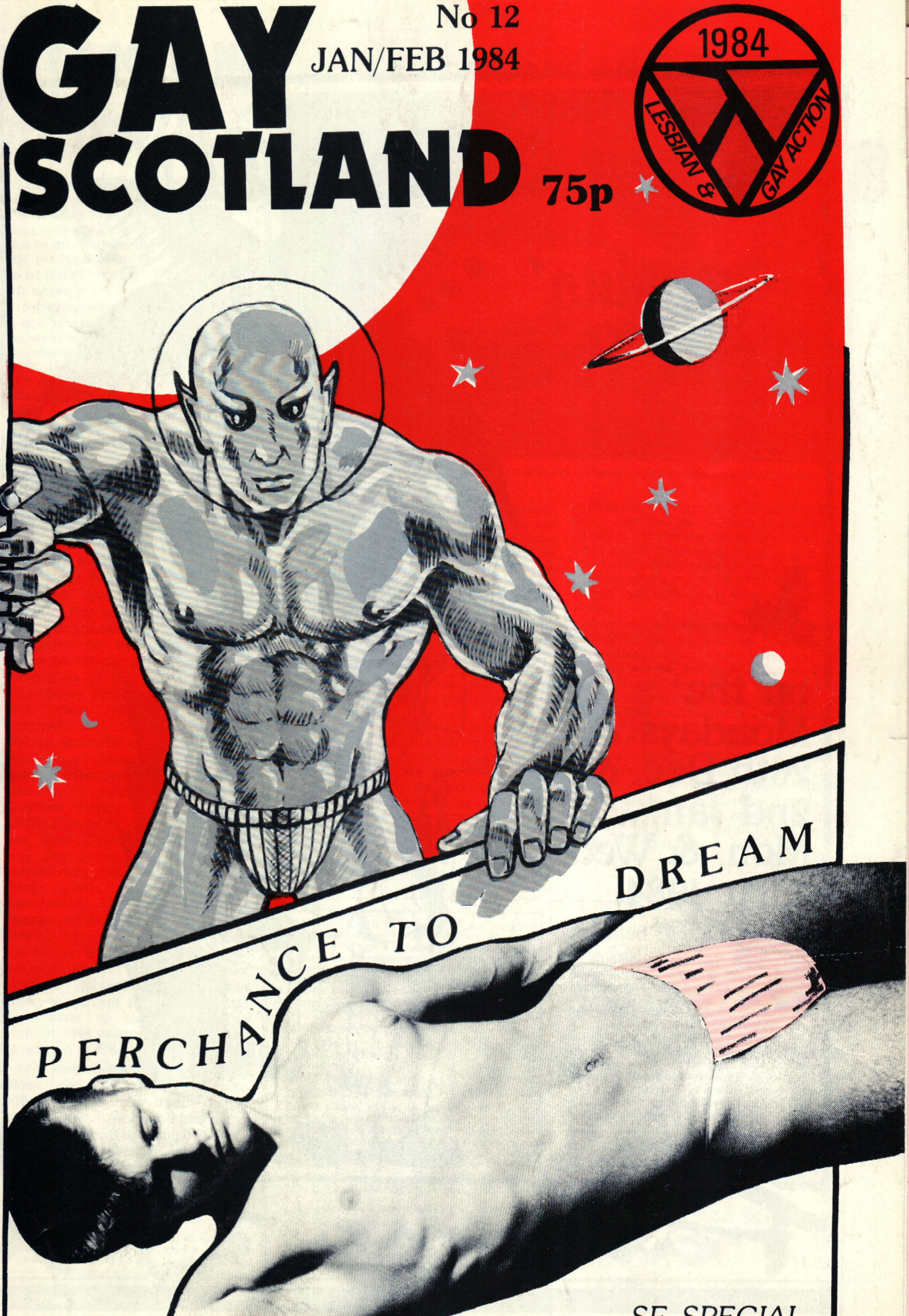
Gay Scotland Jan/Feb 1984

Take, for example, this issue of Gay Scotland from Jan/Feb 1984 – a Science Fiction special. At this time the magazine had a circulation of around 8,000 with the majority of readers subscribing or buying a copy from gay bars and clubs. What is noticeable from the content is that the magazine contains significantly less advertising space than more recent magazines, and offers a plentiful supply of news items, which are unsurprisingly related to LGBT interests and the continuing pursuit of equality and an end to discrimination.

What interested me was the section ‘Scenearound’ detailing places and spaces for LGBT Scots to socialise. A snapshot of the gay ‘scene’ in 1984 offers some opportunity to consider how the ‘scene’ had developed after 1980. There were gay/mixed spaces prior to 1980; in Glasgow; there was the Close Theatre bar, Guys, The Royal, the coffee bar in the Central Hotel, Top Spot Mexicana, The Strand, the Corn Exchange,  and Tennent’s to name a few, but after 1980 there was  growing confidence that commercial premises catering for the LGBT population could be profitable and offer a safe(r) experience for Glaswegian LGBTs.

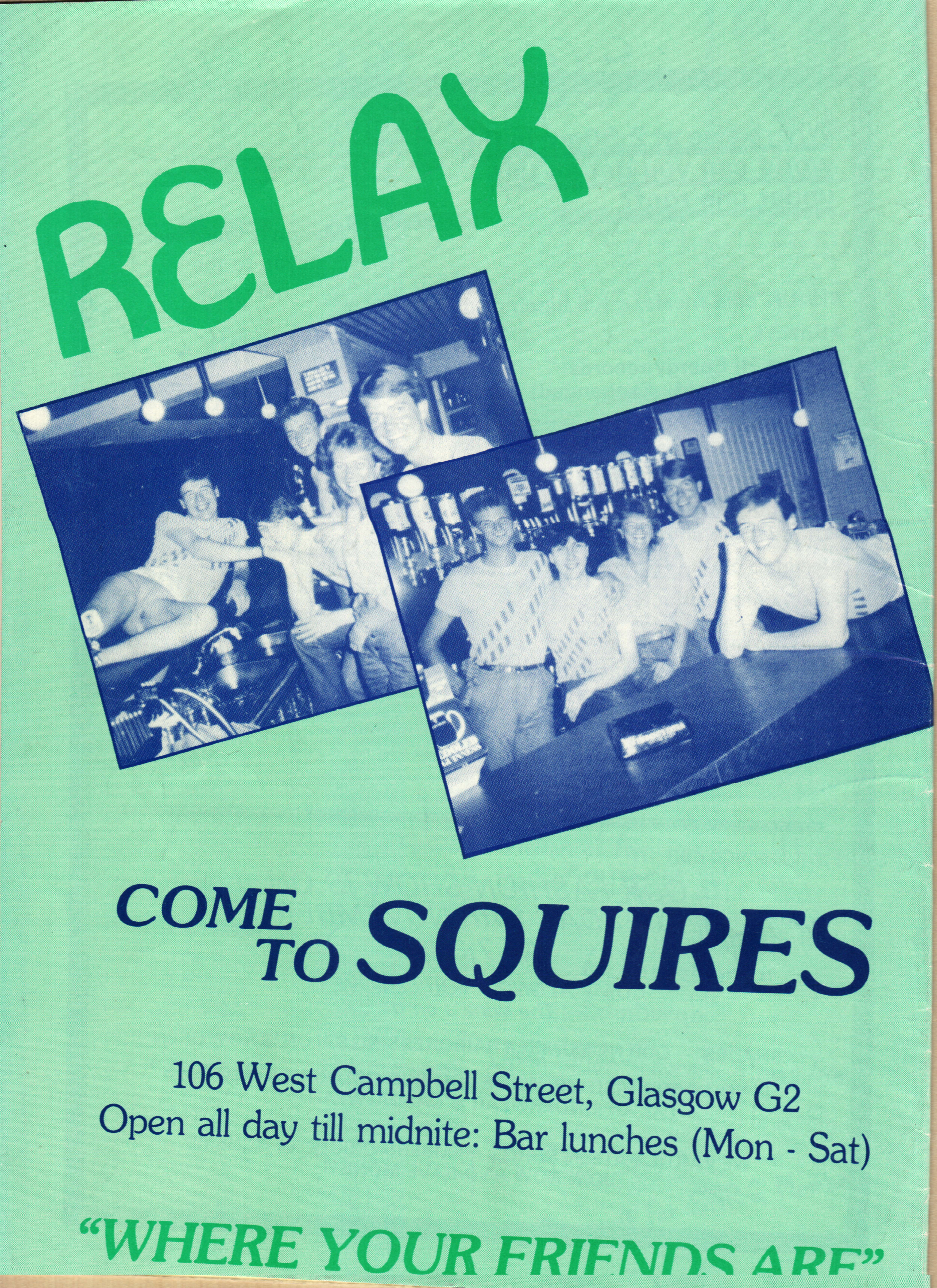
According to the listings there were 13 gay or gay ‘friendly’ pubs ‘n clubs in Glasgow in 1984. Some will be familiar to those of us ‘of a certain age’: Court Bar, Squires, Tennents, The Waterloo, Bennets. But there are more: Bardot’s at 72-74 Broomielaw, incorporating La Maison & Le Village; Studio One on Byres Road (mainly Sundays); Vintners, Panama Jax,  and Halibees Cafe Cabaret. However, due to the transient nature of many ‘gay’ venues, by November Bardot’s seems to have disappeared, and Halibees is no longer listed. New entries include Cul de Sac on Ashton Lane, Chippendales on Clyde Street,  & The Winter Green Cafe. Editorial notes offer readers a glimpse of what to expect: Duke of Wellington – ‘rough, but ready clientele’; Vintners – ‘busy [and] cruisy’; Cul de Sac – ‘trendy…popular with a certain ‘set’; Squires – ‘up market…popular with tourists’.

Squires Lounge
Squires Lounge

If we leap forward another 10 years to July 1994, Glasgow had 16 venues listed, including a new generation of gay pubs ‘n clubs; much more commercial and appealing to the ‘pink pound’ younger market. Café Delmonicas, Club X, and Mondays at The Tunnel boasted a much more music-oriented culture. The ‘old guard’ were still represented by the Court Bar, Squires, The Waterloo,  Austins and, to some extent, Bennet’s but the 90s saw the emergence of a distinctly different form of gay leisure culture. This new culture was characterised by a more confident and market-savvy approach that relied upon a younger and more affluent customer base. Characterful, they were not. But this gay scene was replicating the changes that were occurring more broadly within the leisure industry, which was becoming a more customer-driven platform, and introduced a new phase in the evolution of gay commercial culture in Scotland which saw an alignment with the mainstream.

The language of gay Scottish leisure changed too. Whereas venues in the 1980s might have been described as ‘discreet’, ‘cruisy’, ‘closeted’ or ‘tolerant’, by the mid 1990s such descriptions were absent. These changes were replicated in the LGBT publications of the period too, which reflected increased revenue, appeal, and confidence and were able to expand content to include more than activism and awareness of LGBT issues.

Gay Scotland Nov 1994

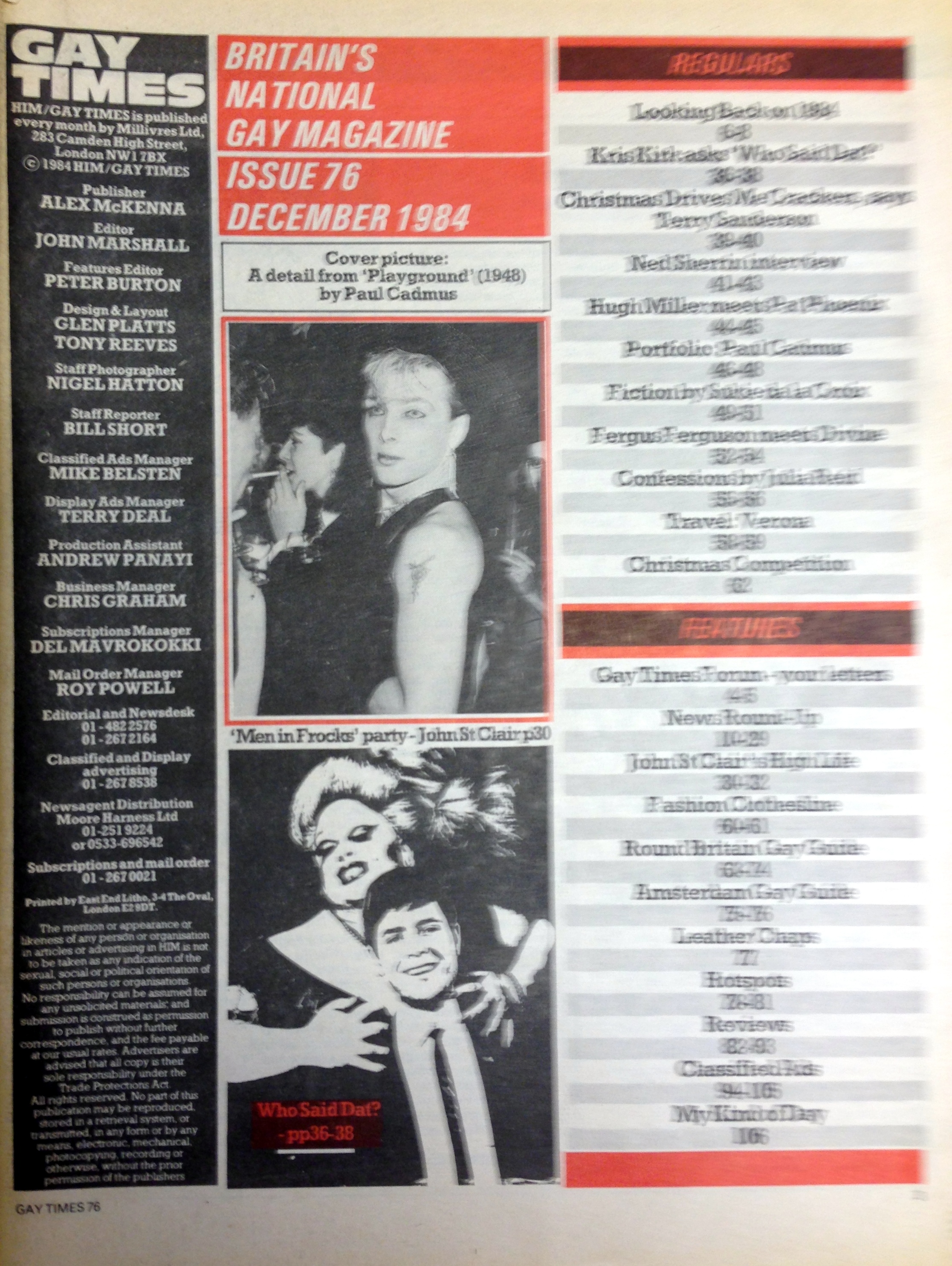
A similar progression can be seen in Gay Times between 1984 and 1994:

Gay Times 1984
Gay Times 1984
Gay Times 1994
Gay Times 1994

The ‘streamlining’ of commercial gay culture in Scotland has led, in some instances, to the narrowing of its appeal. Modern venuesmay be guilty of permitting market forces to disregard sections of the community: the older and less well off, in its drive for profitability and commercial appeal, with LGBT 0ver 50s frequenting venues in fewer numbers. This was certainly a feature evident from my research with gay and bisexual men over 50; some of whom felt that this drive towards profitability over community was gradually excluding the more mature or alternative ‘markets.

Copyright © Jeff Meek 2013-2023

All Rights Reserved.

Equal Marriage, Religion, and Schisms

Part of my doctoral thesis utilised oral history to capture the thoughts and experiences of gay and bisexual men (GBM) who lived (and loved) in Scotland prior to the Criminal Justice (Scotland) Act 1980. This legislation brought legal equity between Scotland, and England and Wales where similar legislation had brought about limited decriminalization of homosexual acts in 1967. In effect, crossing the border into Scotland in 1968 left gay male travellers under the threat of legal sanctions (although in reality this was unlikely for most GBM who preferred the bedroom to the ‘cottage’ or park).

As these interviews were conducted in 2007, 3 years after civil partnerships had become legal for same-sex couples, part of my questioning dealt with the potential for further civil rights being extended to include religious marriage. Only 2 of the 24 men I interviewed believed that such an extension of rights was possible within their lifetime (both men were in their late 50s), thus, I imagine that the other 22 will have have expressed surprise and delight that there now exists  potential for equal marriage rights to be extended to non-heterosexuals in Scotland.

The root of their pessimism undoubtedly lay in the, historically, rather frosty relationship between Scotland’s main churches and non-heterosexual Scots. Although it would be incorrect to suggest that these institutions were responsible for the delay in bringing legal equity between Scotland and its southern neighbours much of the objections voiced in the aftermath of the publication of the ‘Wolfenden Report’ came from religious groups and individuals (most prominently displayed by James Adair, the former procurator fiscal, elder of the Church of Scotland, and member of the Wolfenden Committee who equated gay men with merciless sexual predators). The Church of Scotland was for over a decade vehemently opposed to any lifting of legal sanctions, and the minor Scottish churches (protestant conservatives) felt that any relaxation in the law would lead to God reaching into his armoury for fresh bolts of lightning and plagues of locusts.

Jump forward 50 years and the news that the Church of Scotland is now permitting the ordination of gay ministers is positive but was always likely to encourage the fear of schism that has haunted the Anglican community. News that two congregations in Lewis are contemplating leaving the church can be no real surprise to religious and cultural historians north of the border. The language used by representatives of these two communities is remarkably similar to that heard in the late 1950s. Take, for example, Kinloch minister, the Rev Iain Murdo Campbell:

“If the word of God had the authority, which it should have, the question and debate should not have been in the General Assembly in the first place.” http://www.bbc.co.uk/news/uk-scotland-highlands-islands-22715004

Of course, the Church’s decision (still to be ratified by the Assembly) does not in fact mean that the institution is liberally embracing religious gay Scots who wish to answer ‘the call’. It is simply suggesting that the church will maintain its traditional approach to sexuality (valorising heterosexuality and sex within ‘traditional’ marriage) but will permit ‘liberal’ congregations to appoint gay ministers who are in a civil partnerships. It’s a change, of course, and a positive one, but it’s not revolutionary by any stretch. But one piece at a time.

The minor churches have been consistent in their objections which roughly accord with their 1950s statements. According to the BBC a Free Church of Scotland spokesman claimed: “We don’t understand what’s going on in the Church of Scotland, and suspect the vast majority of the Scottish public don’t have a Scooby (!) either. We believe that Scotland needs the guidance of the national church rooted in the teachings of the Bible, irrespective of public opinion and pressure to conform.” http://www.bbc.co.uk/news/uk-scotland-22580322

The mention of public opinion is, of course, a hot potato. There again the minor churches have been consistent – they saw no value in bowing to public opinion regarding homosexual law reform in the 1950s and 60s (albeit that the Scottish popular press of that period were very much anti-law reform). It would be safe to suggest that these churches will staunchly oppose any form of state interference in the definition of marriage. But, this begs the question, who should define what marriage is? In a secular society we look to government to direct and to react (but not be reactionary), rather than the church. In civil affairs and any decision should not be at the mercy solely of public opinion, but what is right; what brings greater benefits to society and to the individual and surely levelling the playing field and equalising citizenship rights for all is for the greater good.

Considering the difficult relationship Scotland had had in the past with its LGBT citizens it is surprising to see equality so prominently valued. But it’s a pleasant and positive surprise, a feeling most likely to be shared by the GBM I interviewed just 6 years ago, when full legal equality seemed so unlikely. But it is just one further step, and prejudice will not be eliminated until discrimination ceases to be justified by an appeal to tradition, religious or otherwise.

Copyright © Jeff Meek 2013

All Rights Reserved.