Pride: The books that shaped us

This year the National Library of Scotland is 100 years old and we asked people to share the books they love with us. To mark Pride, our panel of LGBT+ individuals will talk about the books and publications that have influenced their lives.

Panellists 

Sasha De Buyl (Chair) is a writer and programmer from Cork. Their work has been published in ‘Gutter’ and ‘The Stinging Fly’ among others. and They are currently undertaking a DFA in Writing at the University of Glasgow.

Graeme Hawley (Head of Published Collections at National Library of Scotland) works at the Library and is used to dealing with millions of books. But out of that huge collection some are more personally significant than others. He shares the books that were helpful to him in his coming out, and a tiny entry in ‘The List’ with a big memory attached to it.

Sigrid Nielsen co-founded Lavender Menace, Scotland’s first lesbian and gay community bookshop, as a partnership in 1982. Sigrid managed author readings, mail order lists, and bookshop events. She left as a partner in 1987 and later co-edited ‘In Other Words: Writing as a Feminist’ (Hutchinson Education, 1987) and published articles and short stories. In 2019, she and Bob revived Lavender Menace as an LGBT+ books archive and heritage organisation.

Other panellists to be announced.

Our audience will also be invited to share memories and recommendations of books that have influenced them.

This event has been developed in partnership with Lavender Menace and will be highlighting their queer books archive.

This event has been programmed as part of WestFest – Glasgow’s biggest cultural and community festival.

BOOK TICKETS

Our Myriad lgbtqi+ Lives

3pm, Wednesday 12th February, Dalhousie 2F11

Speaker, Brian Dempsey, School of Law

All welcome, registration required. Please visit here to register.   

We have always been part of Scottish history, and we continue to make Scottish history.

  • From the 6th century man-loving priest Findchän to the unnamed trans or intersex person (‘skartht’) whose very existence was supposedly a portent of James II’s death (1460)
  • via the ‘female sodomites’ Elspeth Faulds and Margaret Armour (1625), the ‘lesbian         schoolmistresses’ Jane Pirie and Marianne Woods (1810) and the gender fluid paganist William Sharpe/Fiona Macleod (d. 1905)
  • to the fight for repeal of ‘Section 28’ (2000), for marriage rights (2014) and for respect for trans autonomy (ongoing) and infinitely more.

Let’s share and celebrate some of Scotland’s many lgbtqi+ lives.

Exploring queer histories and the diverse experiences of Scotland’s LGBTQ+ community

Gray’s School of Art alumnus, Bart Grabski, hasbeen selected as one of only ten artists to feature in the Queer & Now exhibition, a landmark project organised by Dundee’s Shaper/Caper dance company funded by The National Lottery Heritage Fund.

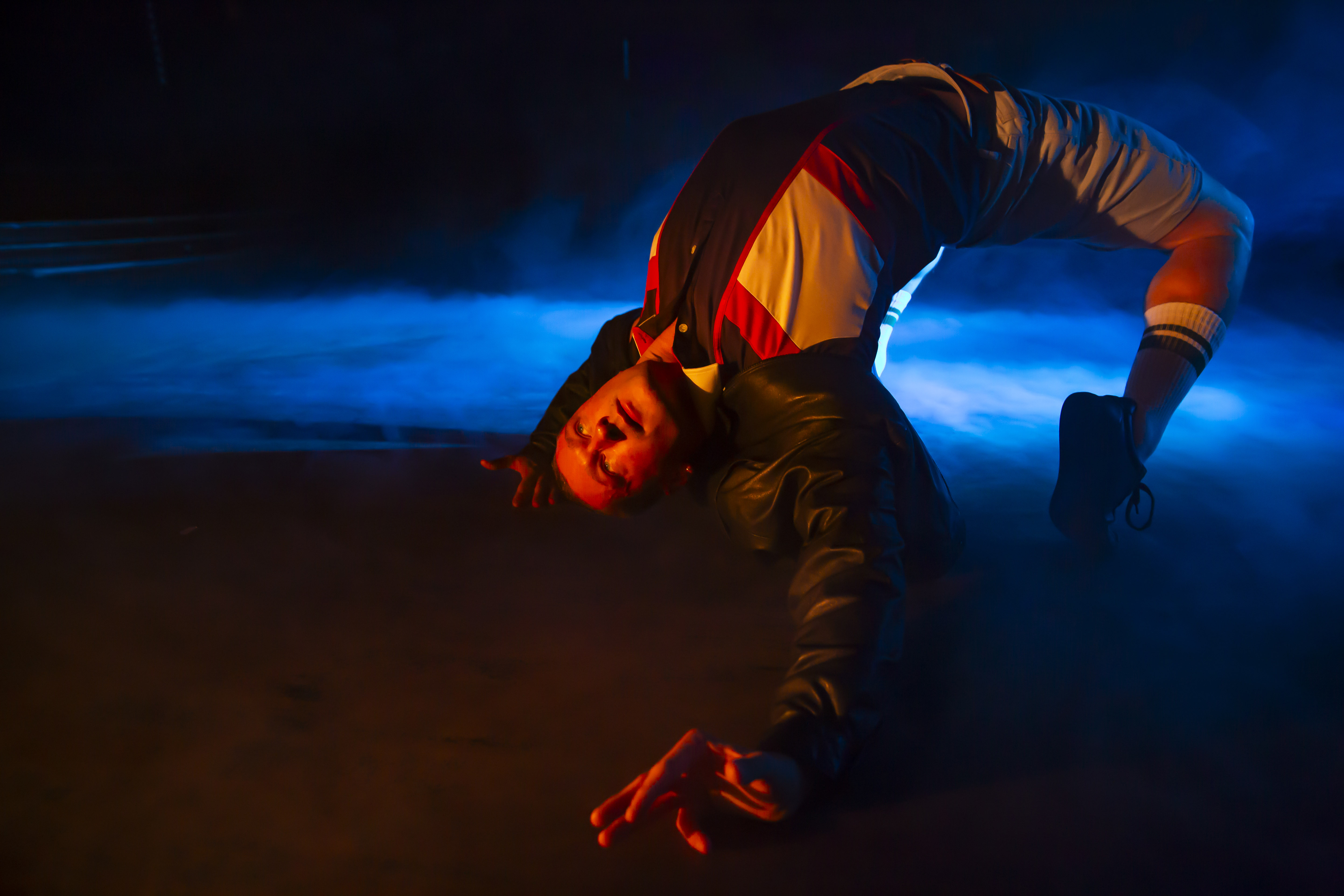
The exhibition, which runs alongside the acclaimed Small Town Boys choreographed by Shaper/Caper’s Artistic Director Thomas Small, explores the rich and diverse experiences of the LGBTQ+ community, with a particular focus on themes from the 1980s and 1990s, including Section 28 and queer nightlife.

Queer & Now showcases new work created by artists who delved into the LGBTQ+ culture of the past, working closely with OurStory Scotland to collect and curate oral histories that have deeply informed their practice.

Bart’s piece, ‘Oral Portraits’, is a poignant exploration of Aberdeen’s queer club scene during the AIDS crisis, documenting a time when underground spaces offered solidarity, resilience, and joy to the community despite oppressive laws.

Reflecting on his artistic journey, Bart said: For many, the dance floor wasn’t just a place to escape—it was a place to become. In a world that tried to erase our community, those nights were the loudest forms of existence. This project isn’t just about remembering; it’s about honouring the resilience, the joy, and the unapologetic celebration of life that thrived in those spaces.” 

Bart’s work weaves together evocative photographic portraits with a soundscape of audio recordings, featuring intimate interviews that echo the spirit of those times. He further explained, “The oral history recordings have been the soul of this project. Each story is a thread in the tapestry of our collective history, revealing not only the struggles but also the triumphs and moments of joy.”

Jill and Colin, who feature prominently in Bart’s work, offer deeply personal insights into the significance of Aberdeen’s queer nightlife. Jill reflects on her self-discovery and the sanctuary provided by Club 2000, where “music and companionship offered an escape from societal repression.” Colin shares his experience with the Gay Switchboard and health promotion during the AIDS crisis, highlighting the importance of safe spaces like Daisy’s Disco and Castros in fostering a sense of belonging and self-acceptance. Colin noted, “Those spaces were not just clubs; they were our lifelines, places where we could be who we really were without fear.”

In addition to his own personal contribution, Bart also conducted interviews with two LGBTQIA+ alumni of Gray’s School of Art, Mark and Cliff, who reflect on their creative practices during those pivotal decades. Both discuss how queer spaces, art, and creativity within Aberdeen provided an outlet for expression and community in the face of social and political challenges.

Mark shared his experience at Gray’s School of Art saying, “Art School enabled me to facilitate my creativity as an honest reflection of my true queer identity. This creative exploration would not have been possible outwith such a liberating environment.”

Cliff, meanwhile, recalls the vibrant creative community of Gray’s School of Art and how the club scene was a lifeline for many: ” Art school was a lifesaver for me, a place where I could be myself, but the queer club scene was where I found my tribe—people who embraced and celebrated their identities.”

Yolanda Aguilar, Executive Director, Shaper/Caper said: “Sharing the history of the LGBT+ community in Aberdeen is a vital thread in the fabric of the city’s past. Sharing these stories allow us to honour the resilience, struggles, and triumphs of individuals who have often been marginalised.

“Gray’s alumnus, Bart Grabski’s contribution to the Queer & Now project has been most relevant in terms of showcasing his unique artistic and interdisciplinary practice, complementing an impressive team of selected artists, whilst spotlighting the North East of Scotland as the fourth city with the highest LGBT+ population, as revealed by this summer’s census.

“Gray School of Art plays an important role by shedding light on the contribution of the LGBT+ community, promoting inclusivity, and ensuring that future generations see the rich diversity that has always been part of Aberdeen’s identity”

The exhibition has travelled across Scotland, opening in July 2024 at Perth Theatre and moving to Inverness, Stirling, and Glasgow, before arriving in Aberdeen at the Anatomy Rooms Arkade Studios from October. The highly anticipated Artist Talk will take place in Aberdeen at the Anatomy Rooms on Friday, 18th October at 4 pm, offering visitors a chance to hear firsthand from artists about the creative process and the stories that shaped their work.

The ‘Queer & Now’ exhibition runs parallel to the ‘Small Town Boys’ show, which delves into queer nightlife in the 1980s through dance and spoken word, offering a complementary exploration of LGBTQ+ experiences during a turbulent time in history. As part of the tour in Aberdeen, ‘Small Town Boys’ will be showcased at Cheers Bar, ensuring that the city has the opportunity to fully engage with both events.

Gray’s School of Art and the wider RGU community are immensely proud of Bart’s accomplishments. His work continues to elevate underrepresented voices, reinforcing the institution’s role as a vital catalyst for social change and cultural discourse. We invite everyone to attend the exhibition and the artist talk, not only to celebrate the legacy of LGBTQ+ histories but also to witness the profound impact of Gray’s School of Art on its alumni and the community at large.

For more details on the Shaper Caper Queer & Now exhibition and project overview visit:  https://www.shapercaper.com/queerandnow.

Buy your ticket to the Small Towns Show:  https://www.aberdeenperformingarts.com/whats-on/dancelive-2024-small-town-boys/#book

Learn more about Our Story Scotland – https://www.ourstoryscotland.org.uk

Bart Grabski, is a Gray’s School of Art alumnus with a MA in Curatorial Practice and a Digital Media Engagement officer at Look Again at Gray’s.

If you would like to write content for Queer Scotland, please get in touch.

‘All High Kicks and Low Morals’: My Introduction to Gay Life in 1960s Glasgow

A Guest Post by William Campbell

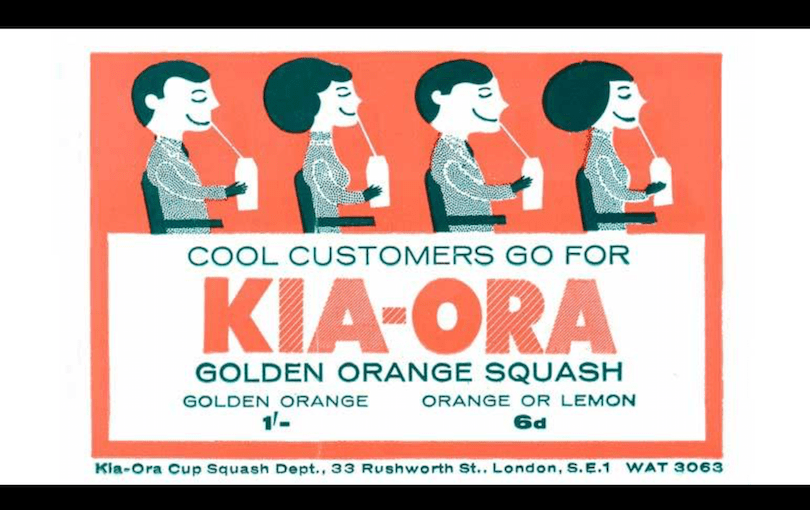
The myth once perpetrated that schooldays are ‘the happiest days of your life’ certainly did not apply to a shy, quiet, non-sporty, spotty youth like me, who wanted to be a fashion designer. I found myself amongst a bunch of growling wannabe engineers and factory workers. Attending a senior secondary in East Kilbride, I wished every schoolday would finish quickly, so I could get back to the safety of home. I only ever felt accepted, and comfortable, in the Art Department, amongst the most gentle, creative, fellow pupils and my very own ‘Jean Brodie’, Mrs Barclay. You could go to her classroom any lunchtime, and she would be playing classical records on her Dansette record player, while we ate peanut butter sandwiches and drank diluting orange juice. The only time I felt happiness and acceptance was in the 5th year, in that class.

He wore a leatherette coat, green corduroy trilby with feather, and a pair of leather driving gloves

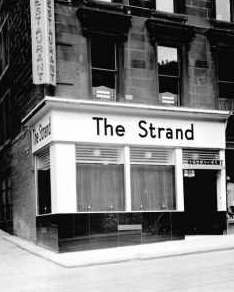
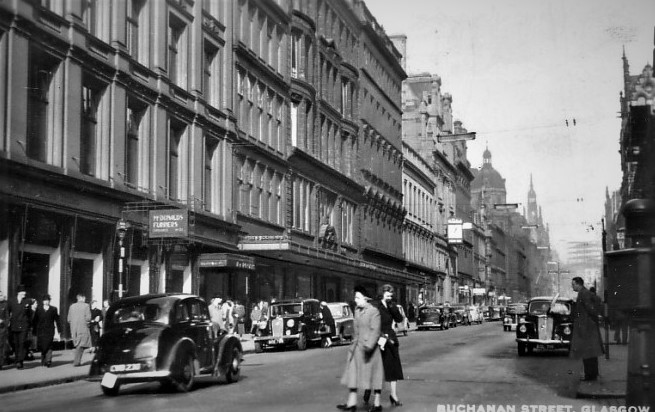
1966 saw me starting work, aged 17, as a junior sales assistant in the menswear department of an upmarket shop in Buchanan Street, Glasgow. For the princely wage of £5 10s 6d a week, I was to learn more about life working in that shop, from a man who would change my perception of myself and other people. He instilled within me the belief that no one was better than you. This was Mr Robertson, the senior salesman, who interviewed me initially for the position. Whilst I had no idea I was gay, he clearly did, possessing a ‘gaydar’ long, long before the birth of the internet dating site. He was 37, quite small, slim, bald, with slightly protruding front teeth, and wore thick horn-rimmed spectacles. He arrived for work drunk most mornings, having spent the evening before on a journey though the 1960s Glasgow gay scene. Starting at the cocktail bar in The Royal, he would then move onto Guys, or The Strand. He wore a leatherette coat, green corduroy trilby with feather, and a pair of leather driving gloves (he had neither a driving licence nor car and bussed it everywhere).

Most mornings Mr R would head straight into the changing room, dim the lights and send me to Ferguson’s (a high-class grocers) in Union Street, for a tin of Epicure white peaches in brandy. It was a long narrow can containing 4 whole fruits in the alcohol liquor. I would hand him the opened can, and having scoffed the contents with a spoon, he would drink the brandy. Then, with an adjustment of his tie knot, and with alcohol level topped up – hey presto! – he was ready to face his public at 9-15am.

Every day in the shop was a performance. You simply did not know what he would say next to the customers (who adored him, I might add). I was both terrified and in awe of him, and could not wait to get in to work every day, just to see what would happen next. He just didn’t care!

He would tell customers he was ‘just back from Tangier’, and ask ‘don’t you love my tan?’, when in fact he had bought a tin of Max Factor Creme Puff, and slathered it on his face.

Mr R lived with his elderly mother in a rented tenement flat in Govan. Yet, when dealing with the mostly wealthy customers in the shop, he spun a web of fantasy about his life. It was so convincing that even I who worked with him, and knew a little about him and his circumstances, had to ask if his stories were true. He would give me a withering look and send me off to make him a coffee. He would tell customers he was ‘just back from Tangier’, and ask ‘don’t you love my tan?’, when in fact he had bought a tin of Max Factor Creme Puff, and slathered it on his face.

One morning he sent me to his mother’s flat for something he had forgotten, and over a cuppa, I said it sounded as if Mr R’s latest holiday in Greece had been fabulous. ‘You must be mistaken’, she said, ‘he spent that two weeks at home, and anyway, he has never owned a passport.’

Mr R would exclaim, ‘Here he comes, all high kicks and low morals’.

Mr R had a frequent visitor to the department, a man called Frank, who in hindsight must have been his boyfriend. Frank was pleasant enough, but a ‘hard ticket’, who was frequently drunk, and black-eyed. They seemed to have been friends for years. They knew a really fun guy, Derek, who was, as they say, ‘a chorus boy’ in variety theatre. He would high-kick his visits to the menswear department, which didn’t go down too well. Mr R would exclaim, ‘Here he comes, all high kicks and low morals’. But actually, he was the sweetest, kindest guy. He was always ‘just going off’ to do summer season in Bridlington or Skegness, and his stories were outrageous.

I worked with Mr R for three of the happiest, funniest years of my life, and before he died, I happened to visit a small menswear boutique on the southside of Glasgow. Thirty years had passed but he still looked pretty much the same. The shop ‘wasn’t quite his style’ and as we chatted, he started sipping on a whiskey he had poured from the side of the till. It was ‘for his nerves’ since he was ‘held up at gunpoint’ a few weeks previously. Held up for some coins and a few pairs of socks? Was that true, or was it right up there with his Moroccan or Greek travels? I have no idea. But I believed it. That’s how good he was.

I understand why the “Mr Robertsons” of those times invented “worlds” for themselves, to just lose themselves in a nicer place where they were safe from harm

Those far off days of the swinging ’60s: Free love, The Beatles, Liberalism. That’s what the media would have you believe anyway. Sure, it was the decade of ‘free love’ but lest we forget, gay men were still going to prison, having to hide their sexuality at work or lose their jobs, were being thrown out of the house for being gay, beaten up…the list is endless and shameful. And all while, Dusty was topping the charts, and having to pretend to be hetero to have a career. I understand why the “Mr Robertsons” of those times invented “worlds” for themselves, to just lose themselves in a nicer place where they were safe from harm.

So, that was my journey: from dreading school, to loving work. Amazing, and all down to him. He would be amazed to be remembered today, but whatever I am today, I owe to him. Here’s to you, Mr Robertson.

Here’s to you, Mr Robertson.

Copyright © Jeff Meek 2013-2024 No part of this site, [QueerScotland.com], may be reproduced in whole or in part in any manner without the permission of the copyright owner.hor.

“Desperately Seeking Someone (Non-camp, No-effems)”: The Gay Personal Ad in Mid-1980s Scotland

By the 1980s the personal ad was fast becoming a popular medium for Scots gay and bisexual men unsure, tired, or weary of the ‘gay scene’ to meet others. During the 1980s these short advertisements were relatively free of the acronyms that would come to dominate the medium and lead to much head-scratching and confusion. Knowing your GSOH[1], WLTM[2], NS[3], WE[4], NSc[5], and OHAC[6] would prove invaluable by the 1990s. But the 1980s were a simpler time when acronyms were largely absent and ads were often focused on presenting a clear descriptor of what advertisers sought.

Lonely-heart advertising was far from an exact science; there was simply no way of determining that your respondents would match your idea of the perfect partner, thus ads had to be explicit about preferences and expectations.  What is evident is the explicit articulation of potential friends’/lovers’ qualities, and the dismissal of those men who might not meet the performative expectations the advertiser had set. ‘Straight-acting’ does appear, but infrequently, in 1980s ads, becoming more frequent in ads during the 1990s, but ‘non-camp’ and ‘non-effem[inate]’ crop up in around one fifth of personal ads during the period 1984-86, in Scottish LGBT magazines. This might be simply about personal choice, but history demonstrates the emergence of countercultures of gay masculinities during the post-war period, which rejected the stigmatised ‘effeminate’ identity closely associated in popular discourse with male homosexuality.

I have already written about gay and bisexual men’s attitudes to masculinity and effeminacy, and this demonstrates how men perceived to be effeminate were stigmatised by both heterosexual and homosexual communities. What is notable is that the majority of personal ads did not contain obvious references to masculinity, but where preferences were indicated these tended to be well determined.  This advertisement from May 1985 clearly frames the advertiser as a ‘non-effeminate’ man seeking others of that type.

Shetland (31) non-effeminate seeks others, this area or visiting.

The terms non-effeminate (and variations) and non-camp appear to be interchangeable. This advert also from May 1985 uses ‘non-camp’ to indicate the preferred deportment:

Glasgow Anywhere Dave (26) 5’10” blond non-camp into most things seeks sincere mates. Photo if possible, returned.

The use of ‘non-scene’ appears regularly to denote both the advertiser’s ‘position’ and that of expected respondents. As Alan Davidson has noted, the appearance of terms such as ‘non-scene’ and ‘non-effeminate’ were coded expressions of the rejection of ‘“stereotypical” presentations of self’.[7] The following ad includes a double-barrelled rejection of ‘camp’ and ‘effeminate’, firmly positioning the advertiser’s rejection of stereotypes, real or imagined, and any individuals firmly associated with stigmatised identities.

Is there [sic] any gay folks in Dunfermline ? Sincere, honest guy seeks friendship of same (21-23), non-camp-effeminate.

Similarly, ‘Fife Guy’, sets his requirements clearly even although his appears to be seeking friends rather than a relationship or hook-up.

Fife Guy (33) Seeks friends, straight-looking, non-camp, non-scene, non-smoker. Photo appreciated. No effems.

Notably, the addition of ‘no effems’ at the end of the ad may represent ‘Fife Guy’s’ uncertainty that ‘non-camp’ would exclude all men he deemed to be non-straight looking.

The next personal ad, from May 1985, emphasises the advertiser’s own concept of masculinity, strongly indicating a preference for ‘straight-looking’ men, further underlined by the requirement that he should married.

Glasgow Slim 34 year-old, masculine looking, passive seeks well-hung marrieds, straight-looking types for uncomplicated fun.

‘Durham Area’ (January 1986) takes discomfort with effeminate men a step further, emphasising his hatred of effeminate men, and his enjoyment of masculine pursuits. He aims to meet a ‘sincere lad’ who might appreciate some ‘old-fashioned loving’. Being fair and genuine did not stretch to gay men who, the advertiser believed, were engaging in gender transgressions.

Durham Area I’m just a fair, genuine guy, 40s. Hate effems. Looking for sincere lad who likes the country, pubs, humour, and a bit of old-fashioned loving.

Ads which refrain from anti-camp or anti-effeminate language occasionally refer to presumed facets of masculinity. Terms such as ‘macho’, ‘manly’, ‘fit’, ‘sporty’ and ‘active’ set an agenda for intimate interaction that is rooted firmly in conventional understandings of gender and gender roles.

The issue of normalcy also emerges from some personal ads. ‘Edinburgh’ (November 1985) describes himself as ‘bearded’ and ‘hairy’, signifiers of masculinity, while detailing his requirements for a ‘non-camp guy’. He ends his ad with a plea for ‘a normal gay person’, further distancing the ‘camp’ man from such a concept.

Edinburgh, W. Lothian, Glasgow. 29 year old bearded hairy bisexual seeks non-camp guy for fun, good times, 25-35. All I want is a normal gay person!

Notably, when perusing Scottish personal ads during the 1990s, the ‘no camp’, ‘no effems’ content appears to have largely disappeared. Whether this is the result of editorial policy or the rise of the cover-all term ‘straight-acting’ is difficult to gauge. Yet, despite some obvious hostility to and discomfort with gay men who did not perform an ‘approved’ version of masculinity, there are ads that counter these negatives. ‘Glasgow Area Athletic’ describes himself as ‘lightweight’, and makes clear that he seeks someone similar, rejecting ‘macho’ men:

Glasgow Area Athletic lightweight guy seeks similar 21-32 years for fun, wrestling exchange. Photos. Any colour, non-macho.

 This type of advert is much rarer amongst the collection analysed. The limited space within personal ads led to a form of personal, sexual and social prioritising which meant that the advertiser attempted to fill ads with details and requirements most important in their search for love, sex and companionship. This inevitably led to exacting requirements which appear judgemental, exclusive and quite often prioritised codes of masculinity.

Copyright © Jeff Meek 2014

All Rights Reserved.

[1] Good sense of humour

[2] Would like to meet

[3] Non-smoker

[4] Well endowed

[5] Non-scene

[6] Own House and car

[7] Alan G. Davidson, ‘Looking for Love in the Age of Aids: The Language of Gay Personals’, Journal of Sex Research 28 (1991), p. 132

Fear, Shame and Hope: AIDS in 80s and 90s Scotland

In a recent blogpost John D’Emilio argued that AIDS and its impact upon LGBT individuals and organisations, the militancy it provoked, and the heightened attention it drew to LGBT causes needs to be more fully documented and appreciated. This is certainly applicable to Scotland, and its responses, both social and medical, to the significant challenges that HIV/AIDS brought.

My research engaged with the impact that HIV/AIDS had upon gay and bisexual men in Scotland, many of whom were relatively young when their lives were touched or influenced by this new and sinister threat to life. Scotland had only decriminalised consensual gay sex between male adults in 1980, and the drive for equality was realistically still in its infancy. This blog post is not an attempt to document Scottish responses to HIV and AIDS but to reflect the experiences of gay and bisexual men during the 1980s and 1990s.

Chris was in his early 20s when the HIV/AIDS ‘dark cloud’ settled over Scotland:

It was horrendous, absolutely horrendous. Fear, fear of something you had taken for granted that was a big part of your identity and how you find joy and happiness and intimacy with other people that could suddenly wipe you out and do it horribly, you know, horribly…it was specifically, gay men who were isolated at that time, so there was another bit of ammunition for people who had a big grudge against gay men or didn’t like homosexuality for whatever reason, there was another huge big bit of ammunition.

Although the majority of early HIV/AIDS cases in Scotland affected another marginalised group – intravenous drug users, especially in Edinburgh – it was not long before the illnesses began to affect Chris much more directly. The impact was felt on a personal and emotional level, but also in the way that gay men saw themselves and were seen by wider society:

JM – Would you say that it impacted on people’s attitudes towards gay men?

Chris – [And] gay men’s attitudes towards themselves, yeah, definitely, and quite negatively, you know. [There was] the condom issue and the campaign with the tombstones and everything else and a leaflet going through every door in Britain, you couldn’t escape it, you really couldn’t escape it, and very quickly from ’80, ’81 people were actually being diagnosed and the first gay man who was diagnosed that I knew, was a friend, and of course then you think, ‘Oh my God!’. He was ill when he was diagnosed so he already had liver complications with diagnosis and deteriorated within a year and a half, two years, and died. His then long-term partner was positive and other really close friends that had been in that circle and had been intimate, one by one were being diagnosed positive.

Chris saw the impact that the disease was having on individuals he cared about but also the impact that it was having on attitudes to homosexuality. Yet, despite increased opprobrium directed at gay men, responses from LGBT organisations were not tempered by hostile attitudes:

JM – How did that impact on a political level in your life?

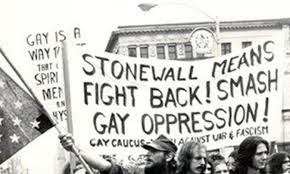
Chris – Yeah, I think that was just another injustice really. It all goes back to London, the sort of Stonewall era and Terrence Higgins Trust and a lot of the things that came up then I don’t think would have surfaced in such a strong, such a political way had it not been for HIV.   HIV and the reaction or the backlash against, particularly, gay men at the time meant [that in a way] those organisations gained incredibly in power and status. [That happened in] Scotland as well because Scottish Aids Monitor were seen as coming and doing something for a community and were put there and funded because they were there to prevent or limit this outbreak within a community but I don’t think even at that stage there was the acknowledgment that the gay scene is not the only the ‘scene’… there’s a far larger percentage of men who have sex with men who don’t and will not put that tag on themselves or be put in that box.

For Ed, who spent time in Australia as well as Scotland, the emergence of HIV/AIDS had a cataclysmic impact upon his life and the lives of his partner, friends and family. Ed was not out to his closest family members and an HIV+ diagnosis prompted him to attempt to tackle issues relating to his sexuality and his health:

Well, it was a double whammy actually: my partner had died of AIDS and I got tested and [the test result] came back positive and I thought, ‘Right! I’ve got to tell them all’, so with my mother it was a double whammy, with her letter I wrote, ‘Dear Mum blah, blah, blah, not only am I gay but I’m HIV positive’ and she wrote back saying that ‘the main thing is that you keep healthy but I think it’s against nature that you’re gay’, just a short reply…

Ed has now been living with HIV for over 20 years, something that was unthinkable at the time:

Well, I was thinking about that a few weeks ago and thinking that it now all seems like a dream…you were going to so many funerals from that period, the late 80s right through to 2000, 2001, so many friends that had died. Well, you knew it was there and you were going from week to week to see who the next one was going to be and so you just had to get on with your life and basically, em, accept and deal with what was happening….and I look at it this way: you either accept what is happening or you just turn your back on it and go off and end it all…

Duncan recalled how the appearance of HIV/AIDS in Scotland impacted upon the attitudes and behaviour of many gay men:

I went doon to see a pal in London recently who had moved down from Glasgow and….he says, “Duncan, do you remember the days in Glasgow when it was just like a chocolate box and you could pick and choose any flavour or any variety you wanted, hard, soft?” and it was true, it was a very carefree…no awareness of AIDS and HIV and anything like that, you know, in these days and everybody was…I cannae say promiscuous, because that isn’t the right word for it, but there was a lot of people who were very active…But then, quite quickly, all of my friends were talkin’ about they’ve maybe knew somebody who actually had contracted HIV an’ once ye knew maybe one person or maybe two it really shoots it home to you and you just started to change your behavior.

Other gay men were overwhelmed by the power of AIDS, not just relating to illness, but the way in which terms such as HIV and AIDS had the potential to obscure the individual, their personalities, who they were:

Greg – I had a friend, who was quite ill herself, who volunteered at a hospice, and one afternoon she brought two guys with AIDS to a café near where I worked. I had met them both before, and my friend invited me to join them for a coffee. I’m ashamed to admit that I didn’t really want to face them. I went and I felt so powerless, so impotent. One of the guys was really very poorly and had mild dementia, and being frank, I couldn’t handle it. I’m ashamed of that, as gay man, I am ashamed of that.

HIV and AIDS also had an impact upon the LGBT rights movement in Scotland during the 1980s and 1990s. As mentioned, decriminalization had only occurred in 1980 and just as LGBT organisations were beginning to find their feet, and their voices, the hysteria amongst sections of British society and the British press had implications for non-heterosexual Scots.

Ed – Oh the nonsense, the sensationalism, the terrible way they treated children who were positive and they weren’t allowed to go to schools, and people were terrified to touch, you know. How they treated [them] in hospital at the beginning was terrible, sliding paper trays through the door to the patients, that sort of stuff, thank God that’s all gone.

Ken too lamented the emergence of further stigmatising discourses concerning the ‘gay plague’ just as confidence amongst sexual minorities was growing.

I think that was a sad thing and a difficult thing…there was parity in 1980 but things don’t change overnight, Joe Public was [still largely homophobic]…so maybe by ’82 we were starting to get somewhere but then [there was] the ‘gay plague’ in America, by ’86 it was here, so there was only that little window [of hope].

These recollections of the 1980s and 1990s are not peculiar to Scotland, but it is notable that the threat of HIV and AIDS emerged in Scotland so soon over after decriminalisation. This had implications for the development of LGBT movements, but despite considerable hostility and homophobia the pressing need for directed health services, and advocacy groups meant that voices silent for so long still demanded to be heard.


Copyright © Jeff Meek 2014

All Rights Reserved.

Please do not reproduce  content from this blog in print or any other media without the express permission of the author.
Risk, Embarrassment, Democracy! Glasgow’s ‘Queer’ Scene, 1955-2008

By the mid 20th century Glasgow was home to a growing non-heterosexual population, and wherever such groups exist there are platforms for social engagement. When I interviewed 2 dozen gay and bisexual men in the mid 2000s, stories emerged which detailed the history and development of the queer scene in Glasgow. I have already produced a map which details many of the venues which catered, publicly or privately, for the city’s non-heterosexual population, but in this blog post I want to flesh out beyond the structural history and engage with the emotional and social history of the queer scene in the city.

Stephen (b. 1939) recalled how he became aware that ‘gay’ bars existed in the city, during the mid 1950s:

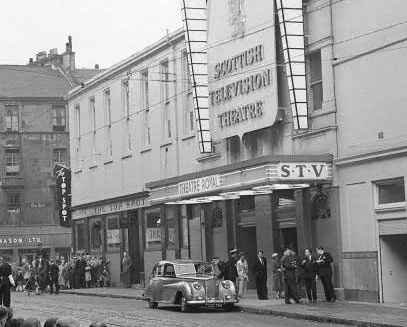
I was in about 19 maybe 20 and I had overheard a conversation with my father and they were speaking about a local celebrity and my father’s colleague had told him about this celebrity being a ‘nancy-boy’ and he also told where this celebrity drank. So, I made up my mind then that I would need to get to this pub to get to know him, this celebrity, because then I would be on equal terms, I would be in a pub on chatting terms and maybe he would put me wise to things. It wasn’t a notorious gay pub, it was a classy pub and lounge bar and cocktail bar, and that’s where I went. It was the ‘Top Spot Mexicana Bar’ at the top of Hope Street.

Top Spot

Stephen was keen to underline that although bars such as the Top Spot attracted a small gay clientele, discretion was still important as many of the patrons were unaware of this. However, in some bars there was an opportunity to be a little less discreet, such as in The Strand bar in Hope Street:

Stephen – When I first went in to ‘The Strand’ bar I didn’t realise …that you got ‘names’….you were either given a name or you were to pick a film star that you admired a lot, female, and they gave you that name. I had picked a film star who I looked nothing like but I did admire and they said ‘you don’t look nothing like her; you’ll need to pick somebody else’. I picked another film star and they thought this was ideal and I got her name.

Queer-friendly bar, Glasgow, 1950-60s

When I asked Stephen if all the gay men took female film star names, he told me that it was generally dependent on sexual role and personality:

Say a lad of 19 or 20, blond hair, came into the bar and he was nice and pretty and polite, they would probably have called him ‘Doris Day’. Whereas, if another lad came in who wasn’t blessed with the best of looks but kept himself as well as he could and was always rather acid when he was speaking to anyone, he would probably been called ‘Bette Davis’.

While Stephen indicated that being able to socialise with other non-heterosexual men gave him ‘confidence’, ‘reassurance’ and ‘psychological comfort’ there was always risk attached to meeting men in bars, even in gay bars.

In these days don’t forget, it was also very dangerous because you got people who were called ‘queer bashers’. So they would pretend [to be gay] until they got the guy up a lane or something and they would [beat him up].

While Stephen became a regular visitor to Glasgow’s queer scene during the 1950s and 1960s, other interviewees preferred to mix with a social group who generally avoided ‘popular’ haunts. Alastair (b. 1948), considers himself fortunate that he was able to become part of a group of largely middle-class men in Glasgow who preferred attending the theatre to socialising with the men in the pubs:

Well, you know, some of them were very attractive people but they were a bit rough. Now, let’s define what we mean by rough here, there is nothing nicer than a bit of ‘rough trade’ but they weren’t. As my late elderly gay friend would say, ‘Not quite in our garden’. I didn’t feel I had anything in common with them and then of course I met one or two pivotal people who introduced me to some very interesting, well-connected people.

There does appear to have been an element of a ‘clash of cultures’ on the Glasgow scene, which was largely the result of class differences.

Alastair – A lovely story about a gentleman in Edinburgh: he and his friend had picked up a long-distance lorry driver who was drop dead gorgeous and he brought him to a dinner party and he wouldn’t eat anything. Our host eventually opened a tin of Heinz Tomato Soup and threw a few croutons in and he wouldn’t eat it because of the croutons and the line of the evening was, ‘I’m a mince and tatties man myself’. So, predominantly I would go to these parties and there was a group of people round the city who almost every Saturday night would have a party. [They were] like-minded, probably slightly more effete men would go to them.

Another of my interviewees viewed the social diversity of the queer scene in Glasgow as something of great importance; where economic and social divisions were overcome through a shared sense of belonging.

Brian (b. 1936) –I went to a gay bar from time to time in town…it was in West Nile Street, it was at the back of a restaurant called The Royal. I remember going to this gay bar in The Royal when by that time I was a local celebrity and [I met] two boys who were an item…one was a joiner from Partick who told me wonderful stories about his early years in Partick, about wandering up Byres Road on a Sunday, and it was deserted – because there was nothing in those days – looking for a pick-up. He knew he’d find it in Botanic Gardens. He came from a working-class family living in Partick probably in one of the tenements just along Dumbarton Road. His mate was a boy who had come up from Ayrshire to work in one of the big stores in Glasgow as a window-dresser or something like that, and whose family had thrown him out when they had discovered that he was gay. The extraordinary thing was that the joiner’s family, who as I say were perfectly ordinary working-class family living on the Pollok estate, had taken him in knowing what the situation was between the two of them. I think one of the things about homosexuality is that it is probably one of the most democratic things…it is a sub-section of society that was probably ahead of its time in terms of the way that the social classes mixed, partly because we were all, if you like, aliens together so whether you came from a working-class background or whether you came from [another] it didn’t matter.

As they gay scene developed in Glasgow during the 1970s and into the 1980s, it took on a political edge, and offered a level of support and socialisation. For Chris (b. 1958) his initial visits to Glasgow’s scene offered more than simple entertainment.

It was really exciting, I think that’s the only word I can really describe it as, it was really different, really, really exciting and it wasn’t like anything else you could experience outside the gay scene and probably the gay scene today but I think as a young man today just coming out and feeling okay in his own skin it felt as if all the shackles had just disintegrated.

As a young gay man, Chris also noticed that the scene in Glasgow also equipped the less experienced with sets of guidelines and advice to maintaining your reputation:

You [were advised not to] pick people up in toilets, you know, there were 3 gay bars in Glasgow and the way to have your reputation absolutely trashed was to go to St Vincent’s Street and pick people up in toilets so there were other rules as important if not more important than the law…

What was occurring during the 1970s and 1980s was the further commercialisation of a queer scene in Glasgow, in an effort to provide (profitable) safe spaces for non-heterosexual men and women to meet and socialise. While some of my interviews viewed this development as a stride forward others felt a sense of disconnect, as Joseph (b. 1959) commented:

You go to [named bar] today and you hear young people say, “What’s that old bastard doing in here?”

What is interesting about these recollections is the diversity of experience. The queer scene in Glasgow during the 1950s & 1960s was governed by discretion. Some interviewees spoke of the democracy of the scene, whilst others noted some elements of division. In the 1970s and 1980s a more confident and identifiable scene emerged, but it still contained something like a paternalistic concern for individual and group welfare. This is not to say that the contemporary queer scene lacks any of these features; individual responses and interactions still govern, to some extent, individual experiences.

Copyright © Jeff Meek 2014

All Rights Reserved.

I’m always interested in hearing more experiences of Scotland’s ‘queer scene’, from the 1940s through to the 1990s.  You’ll find my email address here.

Feelings of Nostalgia and Disconnection among Gay and Bisexual Male Elders in Scotland

Andrew King’s recent piece about older people and homophobia published on the website The Conversation got me thinking about my own research interviewees with gay and bisexual male (GBM) elders, which I undertook in the mid 2000s.

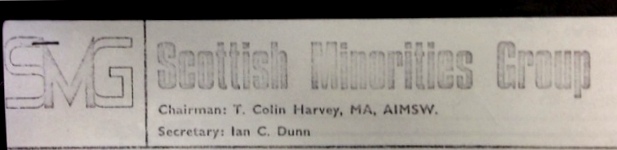
One of the notable issues concerning the homosexual law reform movement in Scotland during the late 1960s and 1970s was that it took on a largely ‘assimilst’ rhetoric. The Scottish Minorities Group (SMG), Scotland’s foremost homosexual law reform organisation believed firmly in the integration of LGB Scots into mainstream society, and demonstrated a sceptical attitude towards more radical organisations such as the Gay Liberation Front. Whether his was the result of a keen understanding of the cultural temperature of Scotland or a deeply held belief that assimilation was most desirable is debatable. What is not open to debate is that the SMG were successful in their campaign. However, some members were uncomfortable with this desire to conform; during the 1970s SMG were to suggest that although the use of police agents provocateurs to catch queer men cottaging was quite wrong, yet they also suggested that men who cruised for sex suffered from behavioural or mental difficulties.

SMGNews

When I interviewed two dozen older gay or bisexual men I was keen to understand whether assimilation and conformity was something that they had sought. Or had they been influenced by more radical approaches. ‘Brian’, born in 1936, saw more radical, politicised campaigning as unnecessarily confrontational. He included PRIDE events in this:

I’ve never taken part in [PRIDE]…and I don’t think I ever would; not my scene… Self-advertisement, there is a lot of that in it too, you know… But there is a certain breed of homosexual that wants to challenge all the time, they want to thrust it in your face.

 Perhaps unsurprisingly, Brian never participated in the gay rights or homosexual law reform movement, but does donate to LGBT support groups and charities. Brian was content separating his life into public and private spheres, only occasionally merging the two. Brian also feels uncomfortable about the contemporary gay ‘scene’; never venturing into gay bars. For Brian the ‘queer scene’ during the 1950s was governed by discretion, a quality that he has become rather nostalgic about. A lack of discretion, according to Brian can be problematic for today’s generation of LGBT Scots, as he described in a recollection of the experiences of a younger gay neighbour:

Until quite recently there were two gay boys living in this street. Funnily enough they had told me that certain people in this street actually shunned them because they were a gay couple. Now, I can believe it up to a point but I think that one of them in particular was kind of challenging people all the time to acknowledge him. He would go on about how they refused to acknowledge my partner…there was this sort of aggressive thing about, ‘You’ve got to recognise me for what I am and not for something else’. Is that necessary?

 Nostalgia for a previous, less ‘complicated’ era may sound rather contradictory. The era is which my interviewees operated was an era where homosexual acts were illegal (although rarely prosecuted unless they took place in public), so discretion was not a choice it was a necessity. All of my interviewees were pleased that things have changed in Scotland, and many were envious of today’s generation who largely avoid engrained homophobia and scepticism. Yet, for some, something had been lost.

Robert, born in 1937:

It’s that slight double life thing and there is a feeling of pleasure in that. [It] fed something in me.

 Yet, despite the ‘simplicity’ of the double life, it has left its mark on Robert’s ability to engage with a modern generation of GBM, and engage in meaningful relationships:

I’m deeply fucking annoyed that I have got to this age and I’m still so unfulfilled in areas of having a good connecting relationship and what fucking chance do I have now because of age and there is a bit of me that knows that I can’t do it but I do feel quite resentful that I have been deprived of that…

Alastair (b. 1948) was also quite nostalgic about being queer in Scotland during the 1960s and 1970s:

[There was a] lot of excitement because there was so much going on and whether or not it was legal didn’t actually matter too much. I can’t remember anybody having a great celebration party when the law changed, it just happened. [There was] a little bit of fear and a GREAT deal of excitement. The 60s were so exciting anyway and you know what they say, if you remember the 60s you weren’t there but I do actually remember quite a lot about it and the 70s were pretty wonderful too!

Queer-friendly bar, Glasgow, 1950-60s

However, one must be careful not to assume that because Alastair, Robert and Brian enjoyed the excitement and thrills of queer life in post-war Scotland, that they were unconcerned about the denial of basic human rights to non-heterosexual men. Perhaps there is a temptation to view the years before decriminalisation as characterised by unrelenting misery, loneliness and isolation but what became clear from my interviews was that queer men created opportunities for pleasure, sex, love and companionship.

When I asked Morris (b. 1933) if he was in any way envious of young LGBT Scots of today he gave it considerable thought:

[Long pause] I think they are enjoying a remarkable freedom….I think they are lucky and yet at the same time, I don’t know. [It’s much easier now] and maybe they just don’t appreciate that. It was fun when you are being criminal you know, and getting away with it, it was fun doing it right under their very noses. You were having the time of your life and they didn’t know, well you hope they didn’t know!

 Morris told me he would much rather have experienced queer life today as a young man rather than queer life in the 1950s but, at the same time, he would not change his past. His experiences, good and bad, helped form who he has become. However, the dramatic shift in lived experience for GBM today as compared to 50 years ago has led, in many instances, to a feeling of disconnect for some of my interviewees. I’ve already detailed Brian’s frustration caused by, in some part, so many years living a double life. Other interviewees told me how they find it difficult or challenging to relate to the ‘younger generation’.

Chris (b. 1958) told me:

When I am talking to gay men just now who are their teens or 20s it’s something they don’t even think about it [the struggle]… Just to be on that Gay Pride march every year in the early stages when people would throw things at you, was a political statement…

For Chris and other interviewees, the past was not another country: it played a part in forming the fabric of today, and some queer Scots of a younger generation are unaware or perhaps unappreciative at the endeavours, both personal and political, of their LGBT elders. While Joseph (b. 1959) has great admiration for this younger generation of LGBT Scots, who he believes, in the main, are aware of past sacrifices and battles, he does believe that commercial interests now dominate the ‘gay community’, which has been reshaped to attract certain groups:

I’m trying no’ tae generalise as it’s important no’ tae generalise but I do find on the commercial gay scene that there is an ageism which is very prevalent. I don’t actually buy into the idea that the gay scene is necessarily welcoming and affirming to everybody. I think individuals in that scene are but I don’t think that the commercial gay scene as a whole necessarily is and I think there is a lot of discrimination at work. You go to [a popular Glasgow gay bar] and you hear young people say, “What’s that old bastard doing here?”

 Of course, ageism isn’t restricted to aspects of LGBT communities but is perhaps more pronounced due to its spatial limitations. Colin (b. 1945) acknowledges the problems of elder LGBT visibility, not only within queer commercial enterprises but within wider society, ‘it’s as if they’re not there…invisible’, but accepts that when he was younger and visiting gay bars in London he also participated, to some extent, in this process: ‘I was drawn into that consumerist world’. Joseph argued that LGBT life should not be measured by the merits and failures of a commercial LGBT ‘scene’, which he feels has been dressed up as being reflective of LGBT experiences. He argued that for many years the LGBT commercial scene was more a ghetto than a community; a place where a marginalised group could theoretically meet, communicate and engage. But as with most ghettos, Joseph feels that it offers you what you want/need for a while until A – you need or are able to find something more rewarding, or B – you no longer feel part of it, or are excluded.

My interviews with these GBM over 50 offered an alternative view of ageing, connection and disconnection, community, and isolation experienced by a sexual minority in Scotland. None of these men wished a return to some sepia-tinted, halcyon queer past but wished to make two main points: queer life during the post-war period wasn’t all misery, gloom and furtive fumblings; there was colour, vigour and plenty of evidence of how queer men shaped their own experiences in the face of hostility, homophobia and potential criminalisation. Secondly, the march of progress, and widening rights was met with relief and joy by these men but they were conscious of how their experiences had led to a measure of disconnection with a later generation of LGBT Scots.

Queer Places

Recently I inherited (after a colleague retired) a large collection of LGBT magazines and ephemera stretching back to the early 1980s. These include numerous editions of Gay Scotland and Gay Times, which are helpful resources when examining the development of LGBT culture over the past 30 years.

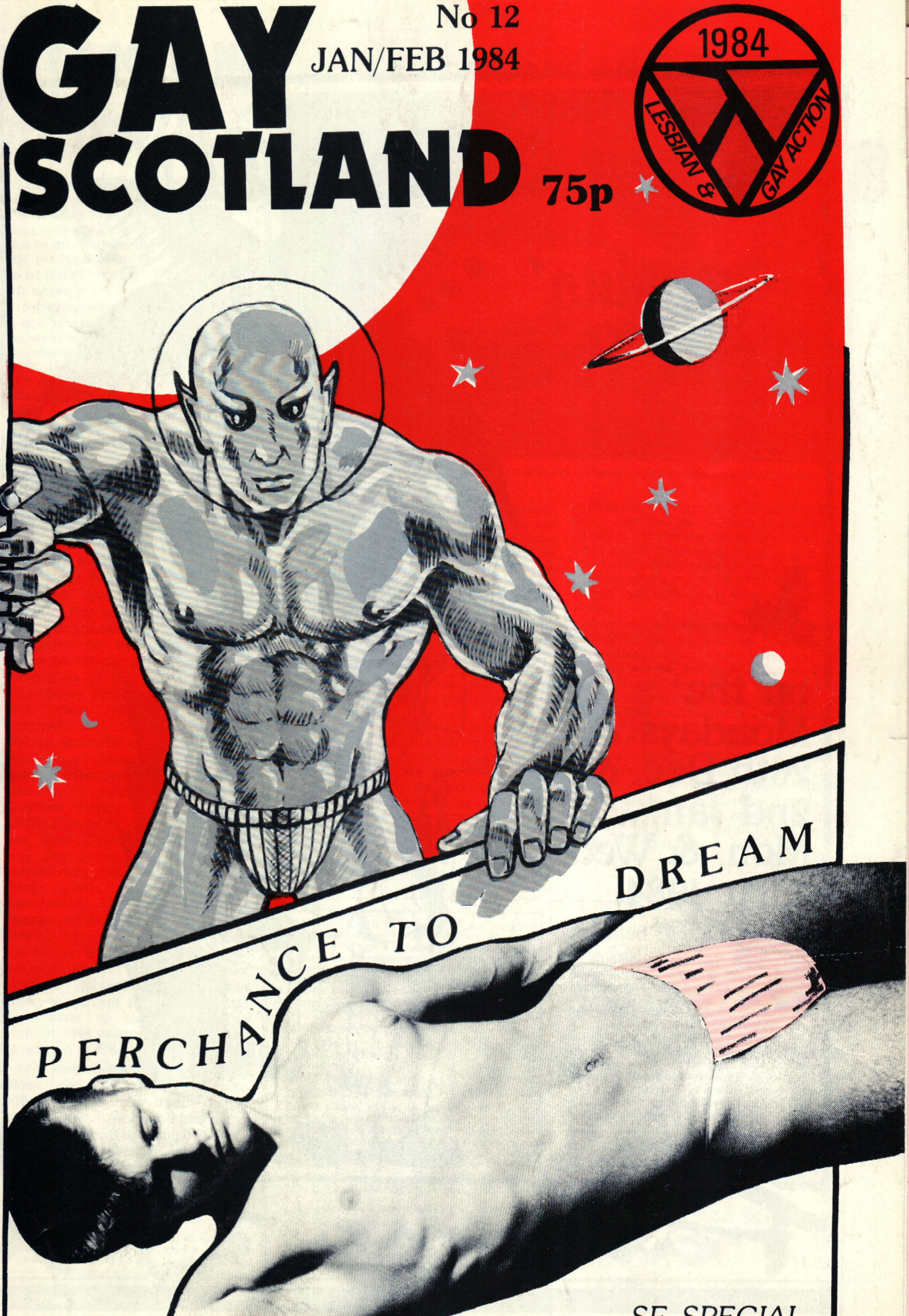
Gay Scotland Jan/Feb 1984

Take, for example, this issue of Gay Scotland from Jan/Feb 1984 – a Science Fiction special. At this time the magazine had a circulation of around 8,000 with the majority of readers subscribing or buying a copy from gay bars and clubs. What is noticeable from the content is that the magazine contains significantly less advertising space than more recent magazines, and offers a plentiful supply of news items, which are unsurprisingly related to LGBT interests and the continuing pursuit of equality and an end to discrimination.

What interested me was the section ‘Scenearound’ detailing places and spaces for LGBT Scots to socialise. A snapshot of the gay ‘scene’ in 1984 offers some opportunity to consider how the ‘scene’ had developed after 1980. There were gay/mixed spaces prior to 1980; in Glasgow; there was the Close Theatre bar, Guys, The Royal, the coffee bar in the Central Hotel, Top Spot Mexicana, The Strand, the Corn Exchange,  and Tennent’s to name a few, but after 1980 there was  growing confidence that commercial premises catering for the LGBT population could be profitable and offer a safe(r) experience for Glaswegian LGBTs.

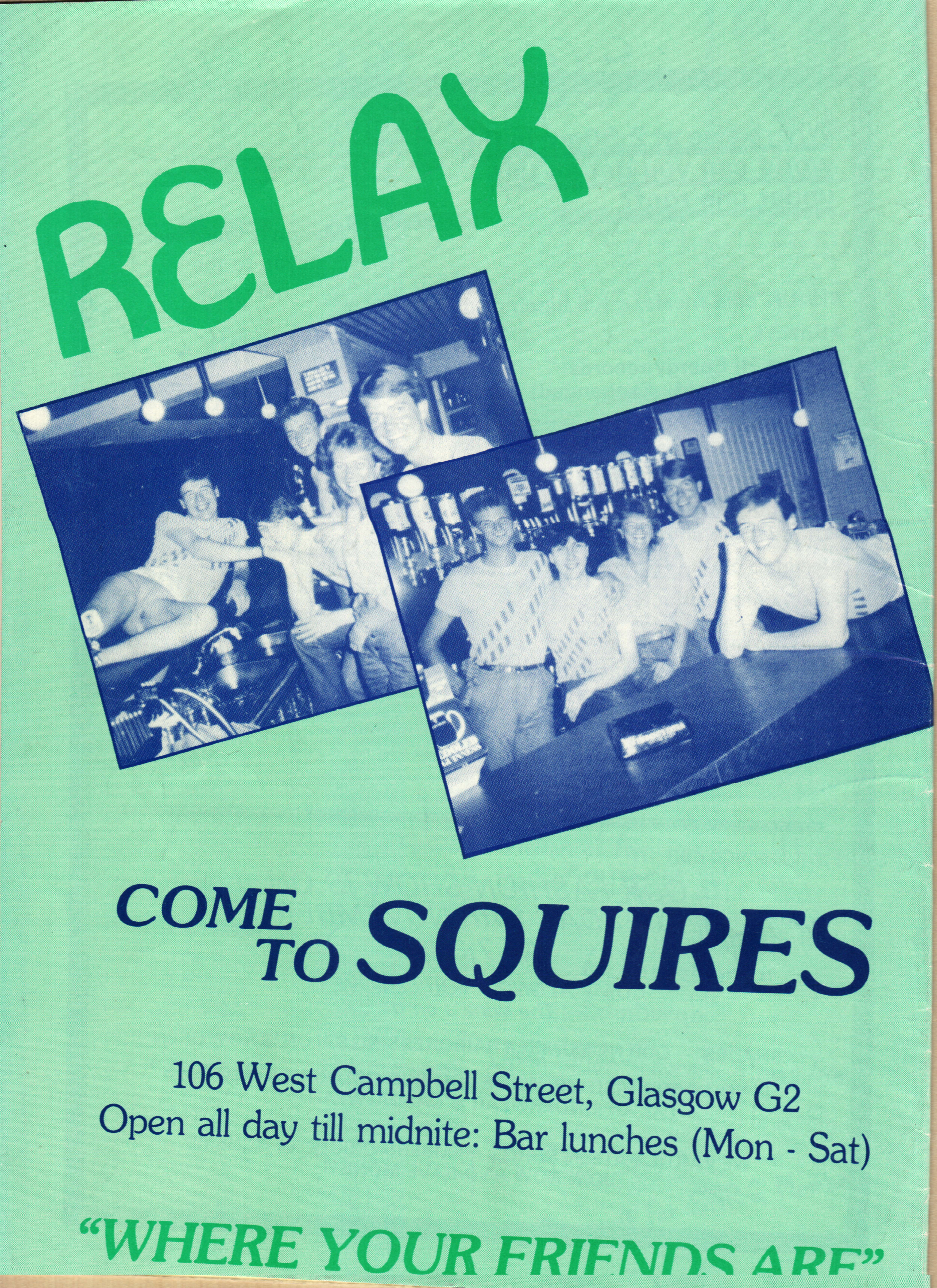
According to the listings there were 13 gay or gay ‘friendly’ pubs ‘n clubs in Glasgow in 1984. Some will be familiar to those of us ‘of a certain age’: Court Bar, Squires, Tennents, The Waterloo, Bennets. But there are more: Bardot’s at 72-74 Broomielaw, incorporating La Maison & Le Village; Studio One on Byres Road (mainly Sundays); Vintners, Panama Jax,  and Halibees Cafe Cabaret. However, due to the transient nature of many ‘gay’ venues, by November Bardot’s seems to have disappeared, and Halibees is no longer listed. New entries include Cul de Sac on Ashton Lane, Chippendales on Clyde Street,  & The Winter Green Cafe. Editorial notes offer readers a glimpse of what to expect: Duke of Wellington – ‘rough, but ready clientele’; Vintners – ‘busy [and] cruisy’; Cul de Sac – ‘trendy…popular with a certain ‘set’; Squires – ‘up market…popular with tourists’.

Squires Lounge
Squires Lounge

If we leap forward another 10 years to July 1994, Glasgow had 16 venues listed, including a new generation of gay pubs ‘n clubs; much more commercial and appealing to the ‘pink pound’ younger market. Café Delmonicas, Club X, and Mondays at The Tunnel boasted a much more music-oriented culture. The ‘old guard’ were still represented by the Court Bar, Squires, The Waterloo,  Austins and, to some extent, Bennet’s but the 90s saw the emergence of a distinctly different form of gay leisure culture. This new culture was characterised by a more confident and market-savvy approach that relied upon a younger and more affluent customer base. Characterful, they were not. But this gay scene was replicating the changes that were occurring more broadly within the leisure industry, which was becoming a more customer-driven platform, and introduced a new phase in the evolution of gay commercial culture in Scotland which saw an alignment with the mainstream.

The language of gay Scottish leisure changed too. Whereas venues in the 1980s might have been described as ‘discreet’, ‘cruisy’, ‘closeted’ or ‘tolerant’, by the mid 1990s such descriptions were absent. These changes were replicated in the LGBT publications of the period too, which reflected increased revenue, appeal, and confidence and were able to expand content to include more than activism and awareness of LGBT issues.

Gay Scotland Nov 1994

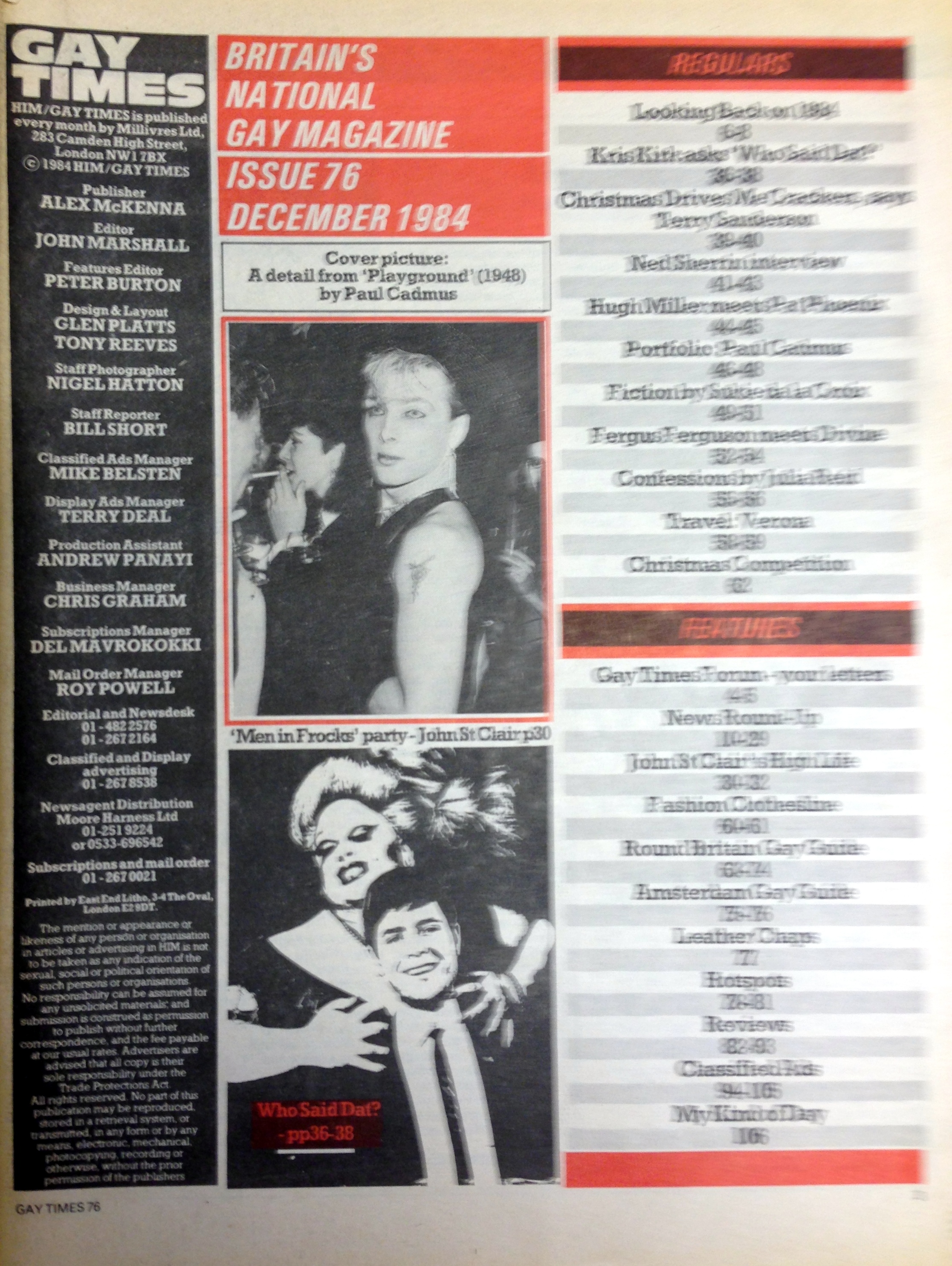
A similar progression can be seen in Gay Times between 1984 and 1994:

Gay Times 1984
Gay Times 1984

Gay Times 1994
Gay Times 1994

The ‘streamlining’ of commercial gay culture in Scotland has led, in some instances, to the narrowing of its appeal. Modern venuesmay be guilty of permitting market forces to disregard sections of the community: the older and less well off, in its drive for profitability and commercial appeal, with LGBT 0ver 50s frequenting venues in fewer numbers. This was certainly a feature evident from my research with gay and bisexual men over 50; some of whom felt that this drive towards profitability over community was gradually excluding the more mature or alternative ‘markets.

Copyright © Jeff Meek 2013-2023

All Rights Reserved.