Queer Places

Recently I inherited (after a colleague retired) a large collection of LGBT magazines and ephemera stretching back to the early 1980s. These include numerous editions of Gay Scotland and Gay Times, which are helpful resources when examining the development of LGBT culture over the past 30 years.
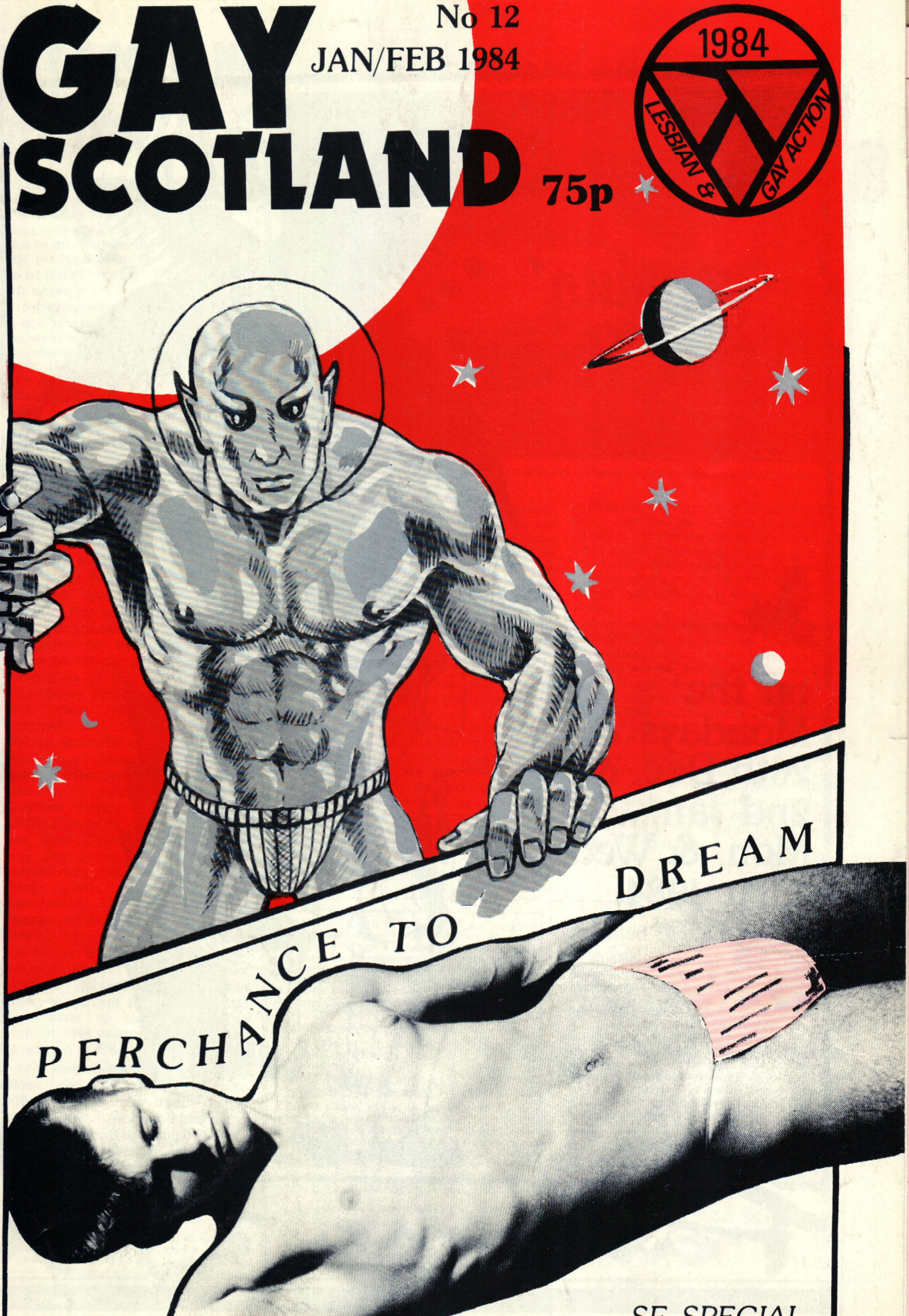
Gay Scotland Jan/Feb 1984

Take, for example, this issue of Gay Scotland from Jan/Feb 1984 – a Science Fiction special. At this time the magazine had a circulation of around 8,000 with the majority of readers subscribing or buying a copy from gay bars and clubs. What is noticeable from the content is that the magazine contains significantly less advertising space than more recent magazines, and offers a plentiful supply of news items, which are unsurprisingly related to LGBT interests and the continuing pursuit of equality and an end to discrimination.

What interested me was the section ‘Scenearound’ detailing places and spaces for LGBT Scots to socialise. A snapshot of the gay ‘scene’ in 1984 offers some opportunity to consider how the ‘scene’ had developed after 1980. There were gay/mixed spaces prior to 1980; in Glasgow; there was the Close Theatre bar, Guys, The Royal, the coffee bar in the Central Hotel, Top Spot Mexicana, The Strand, the Corn Exchange,  and Tennent’s to name a few, but after 1980 there was  growing confidence that commercial premises catering for the LGBT population could be profitable and offer a safe(r) experience for Glaswegian LGBTs.

According to the listings there were 13 gay or gay ‘friendly’ pubs ‘n clubs in Glasgow in 1984. Some will be familiar to those of us ‘of a certain age’: Court Bar, Squires, Tennents, The Waterloo, Bennets. But there are more: Bardot’s at 72-74 Broomielaw, incorporating La Maison & Le Village; Studio One on Byres Road (mainly Sundays); Vintners, Panama Jax,  and Halibees Cafe Cabaret. However, due to the transient nature of many ‘gay’ venues, by November Bardot’s seems to have disappeared, and Halibees is no longer listed. New entries include Cul de Sac on Ashton Lane, Chippendales on Clyde Street,  & The Winter Green Cafe. Editorial notes offer readers a glimpse of what to expect: Duke of Wellington – ‘rough, but ready clientele’; Vintners – ‘busy [and] cruisy’; Cul de Sac – ‘trendy…popular with a certain ‘set’; Squires – ‘up market…popular with tourists’.
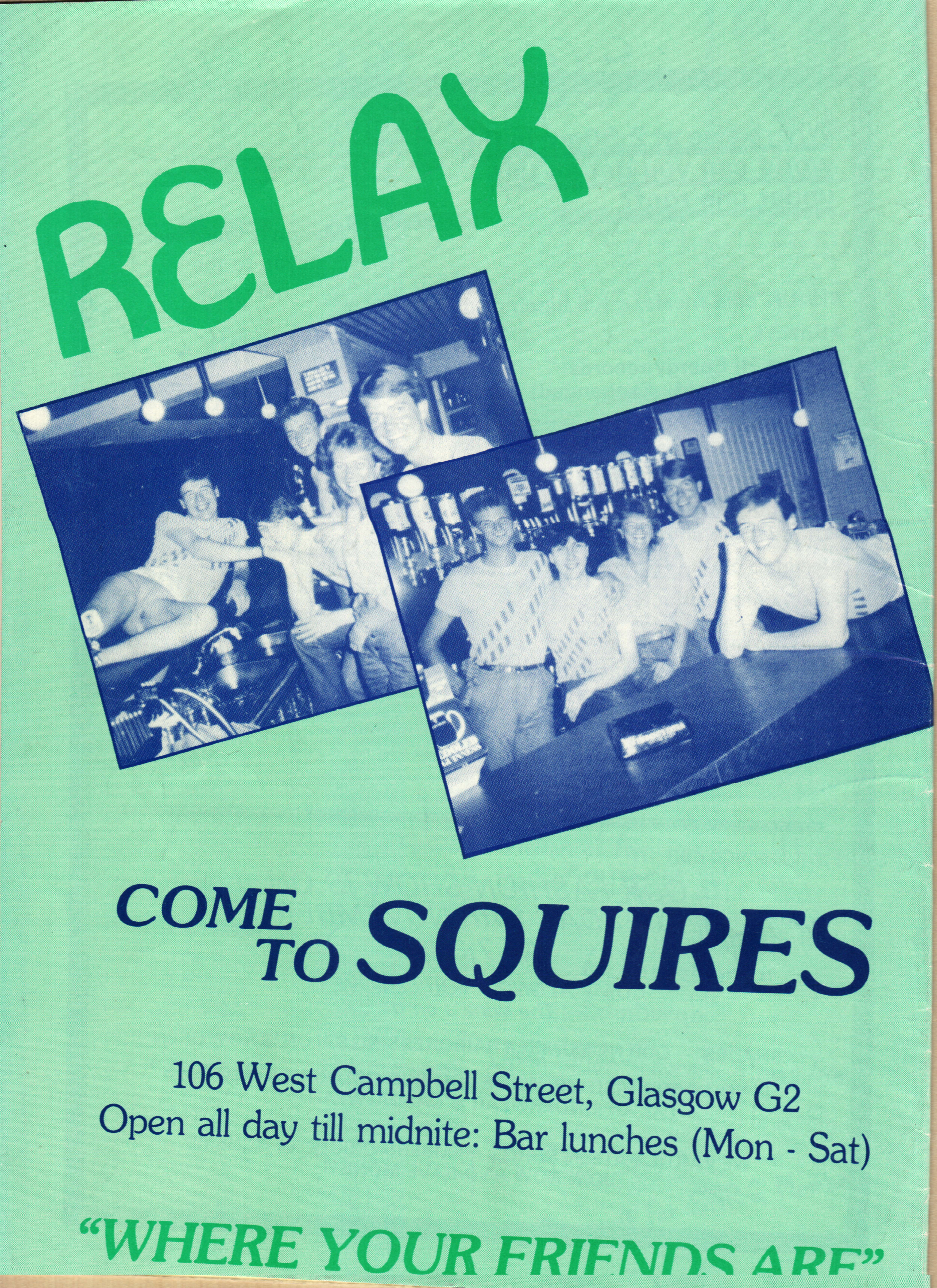
Squires Lounge
Squires Lounge

If we leap forward another 10 years to July 1994, Glasgow had 16 venues listed, including a new generation of gay pubs ‘n clubs; much more commercial and appealing to the ‘pink pound’ younger market. Café Delmonicas, Club X, and Mondays at The Tunnel boasted a much more music-oriented culture. The ‘old guard’ were still represented by the Court Bar, Squires, The Waterloo,  Austins and, to some extent, Bennet’s but the 90s saw the emergence of a distinctly different form of gay leisure culture. This new culture was characterised by a more confident and market-savvy approach that relied upon a younger and more affluent customer base. Characterful, they were not. But this gay scene was replicating the changes that were occurring more broadly within the leisure industry, which was becoming a more customer-driven platform, and introduced a new phase in the evolution of gay commercial culture in Scotland which saw an alignment with the mainstream.

The language of gay Scottish leisure changed too. Whereas venues in the 1980s might have been described as ‘discreet’, ‘cruisy’, ‘closeted’ or ‘tolerant’, by the mid 1990s such descriptions were absent. These changes were replicated in the LGBT publications of the period too, which reflected increased revenue, appeal, and confidence and were able to expand content to include more than activism and awareness of LGBT issues.

Gay Scotland Nov 1994

A similar progression can be seen in Gay Times between 1984 and 1994:
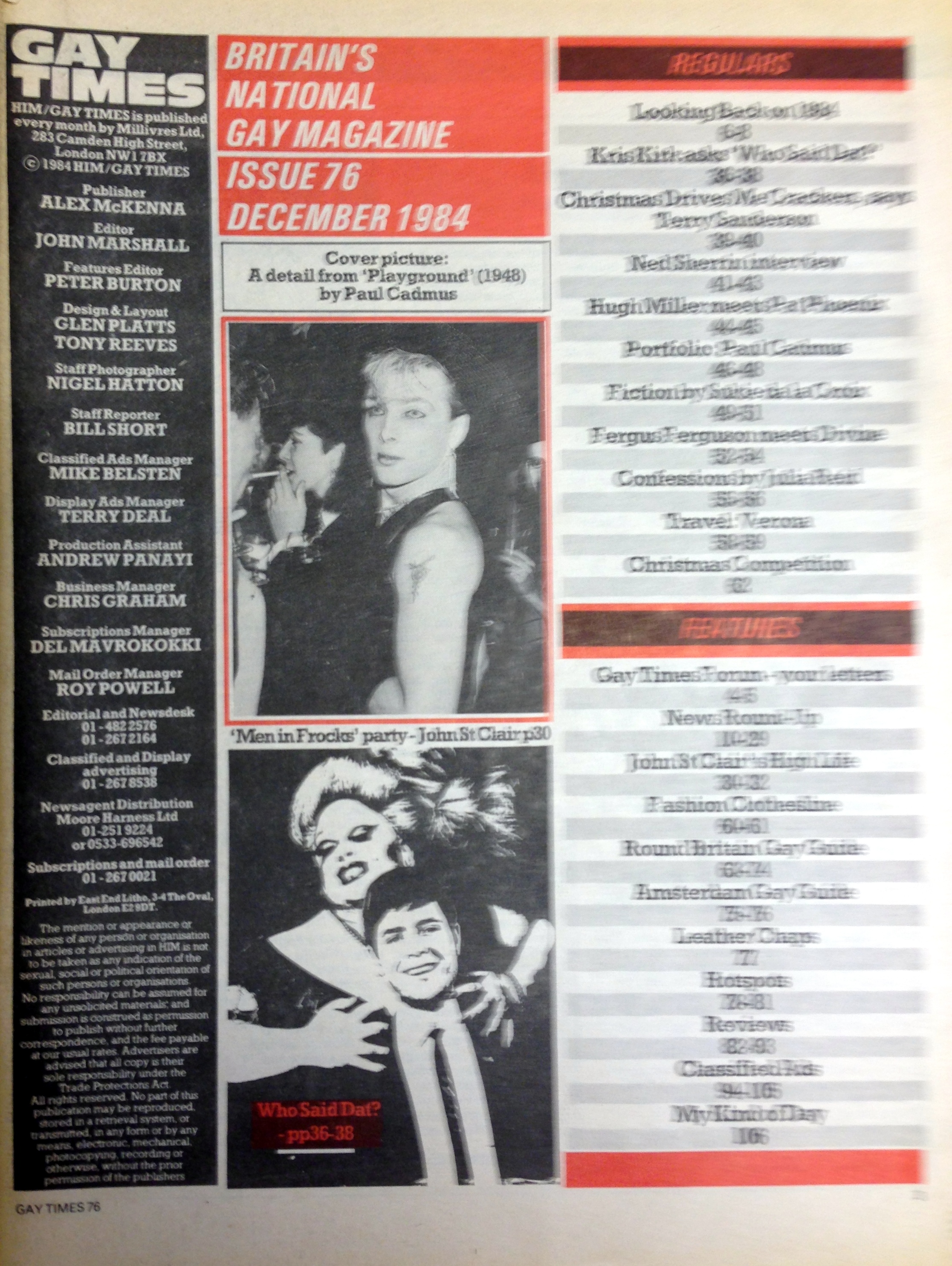
Gay Times 1984
Gay Times 1984
Gay Times 1994
Gay Times 1994

The ‘streamlining’ of commercial gay culture in Scotland has led, in some instances, to the narrowing of its appeal. Modern venuesmay be guilty of permitting market forces to disregard sections of the community: the older and less well off, in its drive for profitability and commercial appeal, with LGBT 0ver 50s frequenting venues in fewer numbers. This was certainly a feature evident from my research with gay and bisexual men over 50; some of whom felt that this drive towards profitability over community was gradually excluding the more mature or alternative ‘markets.

Copyright © Jeff Meek 2013-2023

All Rights Reserved.

Equal Marriage, Religion, and Schisms

Part of my doctoral thesis utilised oral history to capture the thoughts and experiences of gay and bisexual men (GBM) who lived (and loved) in Scotland prior to the Criminal Justice (Scotland) Act 1980. This legislation brought legal equity between Scotland, and England and Wales where similar legislation had brought about limited decriminalization of homosexual acts in 1967. In effect, crossing the border into Scotland in 1968 left gay male travellers under the threat of legal sanctions (although in reality this was unlikely for most GBM who preferred the bedroom to the ‘cottage’ or park).

As these interviews were conducted in 2007, 3 years after civil partnerships had become legal for same-sex couples, part of my questioning dealt with the potential for further civil rights being extended to include religious marriage. Only 2 of the 24 men I interviewed believed that such an extension of rights was possible within their lifetime (both men were in their late 50s), thus, I imagine that the other 22 will have have expressed surprise and delight that there now exists  potential for equal marriage rights to be extended to non-heterosexuals in Scotland.

The root of their pessimism undoubtedly lay in the, historically, rather frosty relationship between Scotland’s main churches and non-heterosexual Scots. Although it would be incorrect to suggest that these institutions were responsible for the delay in bringing legal equity between Scotland and its southern neighbours much of the objections voiced in the aftermath of the publication of the ‘Wolfenden Report’ came from religious groups and individuals (most prominently displayed by James Adair, the former procurator fiscal, elder of the Church of Scotland, and member of the Wolfenden Committee who equated gay men with merciless sexual predators). The Church of Scotland was for over a decade vehemently opposed to any lifting of legal sanctions, and the minor Scottish churches (protestant conservatives) felt that any relaxation in the law would lead to God reaching into his armoury for fresh bolts of lightning and plagues of locusts.

Jump forward 50 years and the news that the Church of Scotland is now permitting the ordination of gay ministers is positive but was always likely to encourage the fear of schism that has haunted the Anglican community. News that two congregations in Lewis are contemplating leaving the church can be no real surprise to religious and cultural historians north of the border. The language used by representatives of these two communities is remarkably similar to that heard in the late 1950s. Take, for example, Kinloch minister, the Rev Iain Murdo Campbell:

“If the word of God had the authority, which it should have, the question and debate should not have been in the General Assembly in the first place.” http://www.bbc.co.uk/news/uk-scotland-highlands-islands-22715004

Of course, the Church’s decision (still to be ratified by the Assembly) does not in fact mean that the institution is liberally embracing religious gay Scots who wish to answer ‘the call’. It is simply suggesting that the church will maintain its traditional approach to sexuality (valorising heterosexuality and sex within ‘traditional’ marriage) but will permit ‘liberal’ congregations to appoint gay ministers who are in a civil partnerships. It’s a change, of course, and a positive one, but it’s not revolutionary by any stretch. But one piece at a time.

The minor churches have been consistent in their objections which roughly accord with their 1950s statements. According to the BBC a Free Church of Scotland spokesman claimed: “We don’t understand what’s going on in the Church of Scotland, and suspect the vast majority of the Scottish public don’t have a Scooby (!) either. We believe that Scotland needs the guidance of the national church rooted in the teachings of the Bible, irrespective of public opinion and pressure to conform.” http://www.bbc.co.uk/news/uk-scotland-22580322

The mention of public opinion is, of course, a hot potato. There again the minor churches have been consistent – they saw no value in bowing to public opinion regarding homosexual law reform in the 1950s and 60s (albeit that the Scottish popular press of that period were very much anti-law reform). It would be safe to suggest that these churches will staunchly oppose any form of state interference in the definition of marriage. But, this begs the question, who should define what marriage is? In a secular society we look to government to direct and to react (but not be reactionary), rather than the church. In civil affairs and any decision should not be at the mercy solely of public opinion, but what is right; what brings greater benefits to society and to the individual and surely levelling the playing field and equalising citizenship rights for all is for the greater good.

Considering the difficult relationship Scotland had had in the past with its LGBT citizens it is surprising to see equality so prominently valued. But it’s a pleasant and positive surprise, a feeling most likely to be shared by the GBM I interviewed just 6 years ago, when full legal equality seemed so unlikely. But it is just one further step, and prejudice will not be eliminated until discrimination ceases to be justified by an appeal to tradition, religious or otherwise.

Copyright © Jeff Meek 2013

All Rights Reserved.